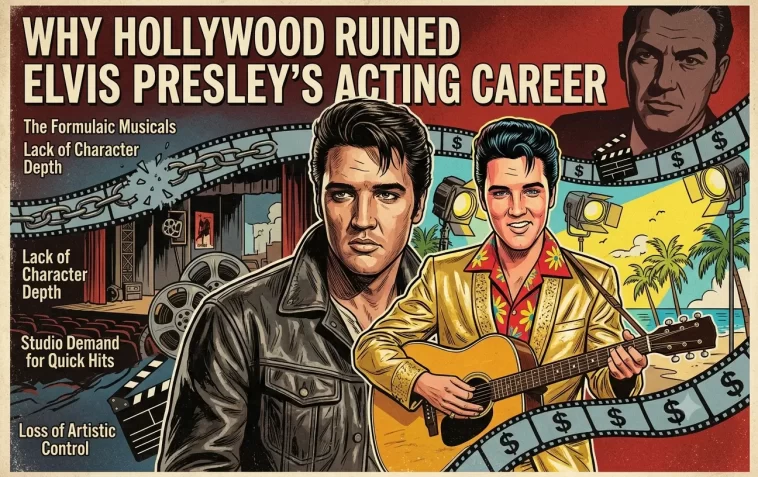
Hollywood ruined Elvis Presley’s acting career in slow motion, one formulaic musical comedy at a time. He didn’t start out chasing shallow beach movies and interchangeable love interests. He started out wanting to be taken seriously as an actor, the kind of performer people compared to James Dean and Marlon Brando. Somewhere along the way, that ambition got traded for a reliable box office formula, and it’s one of the more frustrating “what if” stories in entertainment history.
This is the story of how it happened, who gets the blame, and why the truth is a little more complicated than just pointing at one villain.
Quick Answer
Hollywood shifted Elvis Presley away from serious dramatic acting toward a repetitive formula of musical comedies set in exotic locations, largely because those films were cheap, profitable, and reliably successful at the box office. Manager Colonel Tom Parker prioritized guaranteed income over Elvis’s acting ambitions, and Elvis’s own young fan base ultimately rejected his more dramatic film roles, reinforcing the formula that came to define most of his movie career.
The Actor Elvis Wanted to Be
Before any of the formula took hold, Elvis genuinely wanted to be a dramatic actor. In a meeting with producer Hal Wallis in 1956, he reportedly said his ambition had always been to become a real motion picture actor, a good one. That wasn’t a throwaway line. He took his first film role in “Love Me Tender” seriously enough to memorize the entire script before filming even started.
His early films backed up that ambition. “Jailhouse Rock” in 1957 earned real critical attention, even if some reviewers took issue with its sympathetic portrayal of a convict. “King Creole,” released the same year, is widely considered the strongest evidence of what Elvis might have become as an actor, showing real range as a young singer battling poverty and organized crime.
For a moment, it looked like Elvis might actually pull off the transition from rock and roll phenomenon to legitimate screen actor.
The Army Interruption and the Turning Point
Elvis was drafted into the Army in 1957 and served two years, delaying his acting momentum right at the point it was building. When he returned to Hollywood in 1960, the films that followed told two very different stories.
“G.I. Blues” and “Blue Hawaii” were massive box office hits, built around lighthearted musical comedy formulas with plenty of songs and scenic backdrops. “Flaming Star” and “Wild in the Country,” on the other hand, leaned into more dramatic territory and only turned modest profits by comparison.
That contrast mattered enormously to the people making decisions about Elvis’s career. By 1961, the pattern was clear: audiences wanted musical Elvis, not dramatic Elvis, and the studios and his management responded accordingly.
The Formula Takes Over
Once the box office numbers made the pattern obvious, Elvis’s films settled into a predictable groove that would define most of the rest of his movie career. Sunny locations, breezy plots, a handful of songs, and a love interest, repeated with minor variations across more than a dozen films through the 1960s.
Elvis himself wasn’t blind to what was happening. He reportedly referred to films like “Girls! Girls! Girls!” as little more than travelogues, a fairly blunt admission that he knew the material wasn’t serious cinema. Even so, the films kept getting made, because they kept making money.
“Kissin’ Cousins” in 1963 became something of a case study in just how far the formula could be pushed. Rushed through production, with Elvis playing dual roles, it still turned a profit, proving to studios that an Elvis picture would sell tickets almost regardless of quality. That’s not exactly encouraging news for an actor hoping to be taken seriously.
Colonel Parker’s Role in All of This
Colonel Tom Parker, Elvis’s manager, is usually cast as the main villain in this story, and there’s real evidence to support that view. Parker reportedly turned down opportunities for Elvis to appear in films like “West Side Story” and “Midnight Cowboy,” roles that could have pushed his career in a very different, more serious direction.
According to longtime Parker assistant Byron Raphael, Parker’s core criticism of Elvis was always about his acting. Raphael has said Parker simply never believed Elvis had what it took to become a real actor, not for a moment. That belief, combined with Parker’s well-documented focus on maximizing short-term financial deals over Elvis’s long-term artistic goals, shaped years of decision-making.
Parker also took a commission of up to fifty percent of Elvis’s earnings, an unusually high cut compared to typical management deals at the time. Keeping Elvis on a steady, formulaic film schedule wasn’t just easier. It was directly profitable for Parker himself, since movie contracts came bundled with soundtrack albums that satisfied Elvis’s separate recording obligations to RCA.
It Wasn’t Entirely Colonel Parker’s Fault
Here’s where the story gets more complicated than the popular version usually admits. Several film historians who’ve studied the era closely push back on the idea that Parker alone destroyed Elvis’s acting ambitions.

A few key points complicate the simple “Parker ruined everything” narrative:
- Elvis’s own fans rejected his dramatic films. “Flaming Star” and “Wild in the Country” underperformed at the box office specifically because young audiences wanted musical Elvis, not serious-drama Elvis.
- Parker’s Hollywood contracts reportedly focused on money, not creative control. According to a 1964 Variety report, the Presley-Parker partnership was known for limiting its Hollywood demands almost entirely to cash terms rather than script or casting influence.
- Elvis never took formal acting lessons and, by several accounts, wasn’t entirely focused on reshaping his own career trajectory once the formula proved successful.
- Producer Hal Wallis originally saw Elvis primarily as a teen box office draw, a replacement for the fading Martin and Lewis comedy duo, rather than as a dramatic leading man from the very beginning.
None of this clears Parker completely. He absolutely had opportunities to advocate harder for his client’s stated ambitions and largely chose not to. But the full picture involves a young fan base with clear preferences, a producer looking for a specific type of star, and an actor who, whatever his early ambitions, ultimately accepted the formula rather than fighting it.
The Missed Opportunities That Still Sting
A few specific rejected roles get cited again and again by fans and historians as evidence of what could have been. Parker’s decision to pass on “West Side Story” and “Midnight Cowboy” are the most commonly mentioned, both films that went on to become major critical successes for other actors.
Perhaps the most painful missed opportunity came later. Colonel Parker reportedly turned down the lead role for Elvis opposite Barbra Streisand in the 1976 remake of “A Star Is Born,” a serious, award-caliber part that could have shown off exactly the kind of vulnerability Elvis had flashed briefly in “King Creole” nearly two decades earlier. By the time that offer came around, though, Elvis’s health and personal life were already in serious decline, raising real questions about whether he could have delivered the performance even if he’d taken the role.
How Critics and History Have Judged the Films
At the time, most of Elvis’s post-Army movies were critically panned even as they performed well financially. Reviewers consistently dismissed the formulaic musical comedies as shallow, interchangeable, and beneath whatever talent Elvis had shown in his earliest films.
Modern reassessments tend to be a little more generous, though not by much. Critic scores across Elvis’s film catalog vary enormously, reflecting the real gap between the promise of his early work and the repetitive formula that dominated the rest of his filmography. Most film historians today view his movie career less as a showcase of serious acting talent and more as a cultural artifact of 1950s and 1960s youth rebellion, valuable for what it represents rather than for the performances themselves.
Why This Story Still Resonates
There’s something genuinely sad about watching an ambitious young performer with real early promise get boxed into a formula that made everyone money except his own artistic reputation. Elvis wanted to be remembered as a serious actor. Instead, he’s remembered as a cultural icon who happened to make a lot of movies, most of which even he didn’t take seriously.
The frustrating part is how avoidable it feels in hindsight. “King Creole” proved Elvis had real range. A handful of better decisions, a manager willing to gamble on serious roles, or simply a young fan base more receptive to dramatic material, and the whole trajectory could have looked completely different.
FAQ
Did Elvis Presley want to be a serious actor? Yes. Elvis stated his ambition to become a real dramatic actor as early as 1956, and he took his early film roles seriously, including memorizing the full script for his debut film “Love Me Tender.”
Which Elvis movie is considered his best acting performance? “King Creole,” released in 1958, is widely considered the strongest evidence of Elvis’s dramatic acting potential, showcasing more range than most of his later formulaic films.
Did Colonel Tom Parker really turn down West Side Story for Elvis? Yes, according to multiple accounts. Parker reportedly declined opportunities for Elvis to appear in “West Side Story” and “Midnight Cowboy,” both of which became major critical successes for other actors.
Why did Elvis keep making formulaic movies if he didn’t like them? The formulaic musical comedies were consistently profitable, and both Parker and the studios had strong financial incentives to keep the pattern going, even after Elvis privately referred to some of the films as travelogues.
Was it entirely Colonel Parker’s fault that Elvis stopped getting serious roles? Not entirely. Historians point out that Elvis’s own young audience rejected his more dramatic films at the box office, which reinforced the studios’ and Parker’s preference for the safer musical comedy formula.
Did Elvis ever get another chance at a serious dramatic role later in his career? Yes, but he didn’t take it. Parker reportedly turned down the lead role opposite Barbra Streisand in the 1976 remake of “A Star Is Born,” a decision many fans and historians still consider one of the biggest missed opportunities of his career.
Editor’s Opinion
honestly i think its a mix of blame not just parker, even tho hes an easy target. elvis’s own fans kinda ruined it too if we’re being real, they wanted beach movies and songs not serious drama. but man, king creole shows he actually had something there, makes u wonder what a different career path couldve looked like. still sad he never got a real shot at somthing like a star is born, feels like a genuine missed chance not just fan theory.