Elvis Presley’s black leather suit came within a hair of never existing at all. The outfit that’s now one of the most famous stage costumes in music history almost got replaced by a cardigan sweater and twenty Christmas carols. If a handful of people hadn’t pushed back at exactly the right moment, the whole thing would have gone very differently.
This is the story of how a corny holiday special turned into the raw, sweat-soaked comeback that saved Elvis’s career, and how close it came to falling apart before a single frame was ever filmed.
Quick Answer
Elvis’s black leather suit for the 1968 Comeback Special almost never happened because his manager, Colonel Tom Parker, originally wanted a tame Christmas special with Elvis in a cardigan singing carols by a fireplace. Director Steve Binder fought for a raw, live performance instead, and even after that battle was won, Elvis nearly backed out on the actual night of filming.
The Special That Was Supposed to Be a Christmas Album With Pictures
By early 1968, Elvis hadn’t performed live in front of an audience in seven years. He’d spent most of the decade cranking out formulaic Hollywood movies, and while the paychecks were good, his relevance as a musician was slipping fast. The Beatles and the Rolling Stones were dominating the conversation. Elvis was starting to feel like yesterday’s news.
Colonel Parker, Elvis’s manager, negotiated a deal with NBC for a television special, but his vision for it was about as safe as it gets. Parker wanted Elvis to walk out in a tuxedo, park himself in front of a fireplace and a Christmas tree, and sing roughly twenty holiday songs with almost no talking in between. Think Bing Crosby or Perry Como, not rock and roll.
Producer Bob Finkel knew that version of the show would do nothing for Elvis’s career. Instead of arguing with Parker directly, Finkel quietly brought in a young director named Steve Binder, who had just three years earlier worked with acts like the Rolling Stones and James Brown on the concert film T.A.M.I. Show. Binder had a completely different idea of what this special should be.
Steve Binder’s Gamble
Binder didn’t sugarcoat his pitch to Elvis. He told him bluntly that he hadn’t seen Elvis’s name on the charts in years, and that a national television special was a make-or-break moment. If it flopped, Elvis would still be remembered fondly for his old hits and movies, but his career going forward would be finished. If it worked, every door would open back up.
That conversation lit a fire under Elvis. He agreed to Binder’s vision: a stripped-down, live performance built around the music that made him famous in the first place, not another round of syrupy holiday standards.
Parker was furious about losing control of the concept. According to Peter Guralnick’s biography Careless Love, Elvis publicly sided with Parker in meetings to keep the peace, then turned to Binder the moment they left the room and made his real feelings clear. Eventually, Parker managed to negotiate a face-saving compromise with NBC, letting the show go ahead as Binder and Elvis wanted it, in exchange for squeezing in a single Christmas song, “Blue Christmas,” near the end.
Enter Bill Belew and the Leather Suit
With the concept settled, the next question was what Elvis would actually wear. On June 11, 1968, Elvis sat down with costume designer Bill Belew to plan out his wardrobe for the special. It was the first time the two men had worked together, and it turned into one of the most important partnerships of Elvis’s later career.
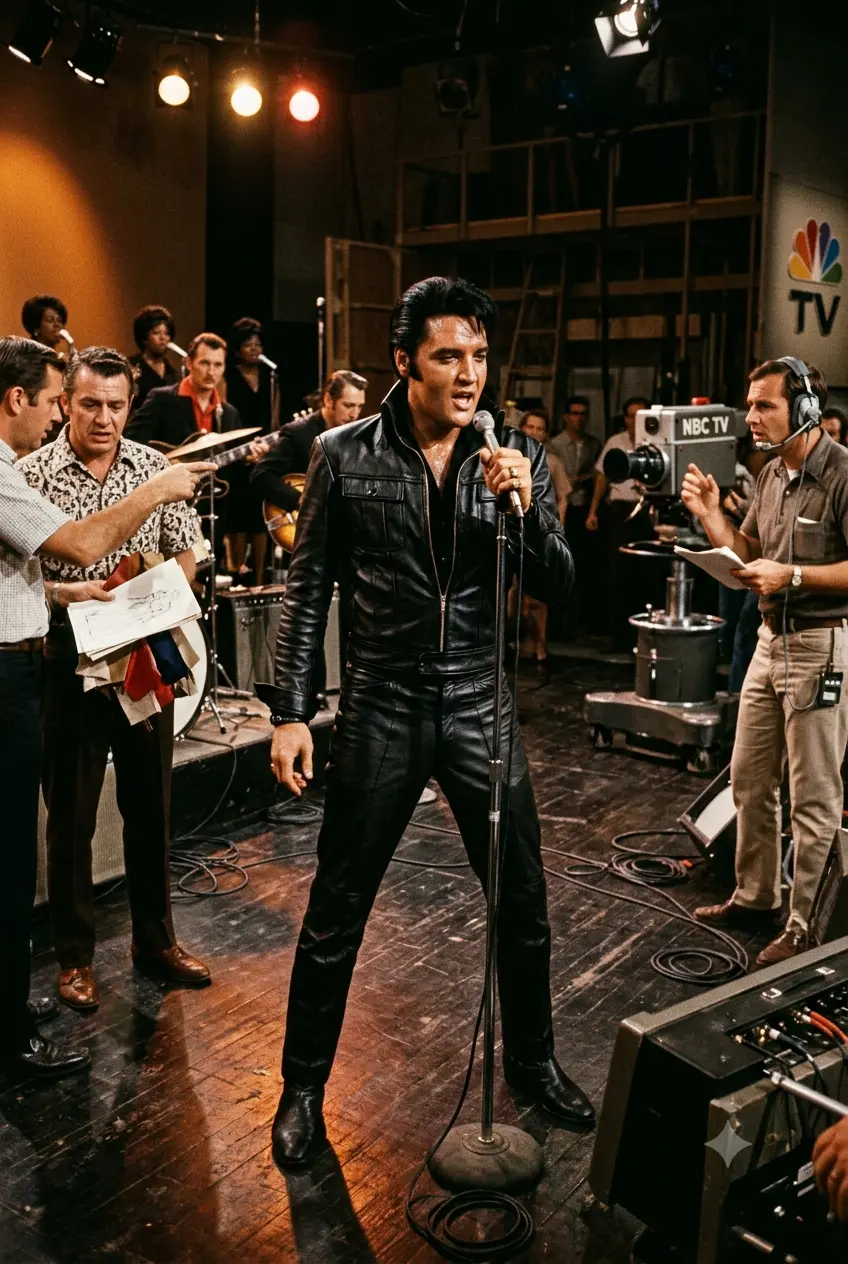
Belew’s centerpiece design was a fitted black leather jacket and matching trousers, cut close to Elvis’s body to show off the physique he’d spent weeks training to get back into shape. Reportedly, it became Elvis’s personal favorite, and he ended up wearing it for the bulk of the show.
The leather wasn’t just a fashion choice. It deliberately echoed the rebellious, James Dean and Marlon Brando style of the 1950s, tying the “new” Elvis of 1968 back to the rock and roll troublemaker who first shocked America over a decade earlier. It was nostalgic and dangerous at the same time, which was exactly the image Elvis needed to reclaim.
The Night Elvis Almost Walked Away
Even with the leather suit finished and the concept locked in, the special nearly collapsed at the very last moment, and this time it wasn’t about wardrobe or Colonel Parker.
On the day of filming, Binder got word that Elvis wanted to see him in his dressing room. He found Elvis already dressed in the black leather suit, but visibly shaken. Elvis told him, apologetically, that he couldn’t go out there. His mind had gone completely blank, and he was terrified of embarrassing himself in front of a live audience after seven years away from the stage.
It’s a strange twist that the same dressing room had, just days earlier, given Binder the idea for the show’s now-legendary “sit-down” segment, where Elvis jammed informally with his old bandmates. That relaxed, unscripted energy is exactly what convinced Binder the special needed a looser, more personal moment built in. Now that same room was where Elvis nearly pulled the plug on the entire broadcast.
Binder talked him through it, reassured him, and got him back on track. Elvis walked out, leather suit and all, and delivered one of the most talked-about performances of his career.
A Suit That Took a Beating
The leather suit didn’t have an easy night, either. Elvis’s performance was so physical and full-throttle that the outfit reportedly needed to be patched up more than once during filming just to hold together.
There’s also a well-documented, slightly bizarre detail from that shoot: producer Steve Binder later wrote that Belew discovered Elvis’s leather pants needed more than just a wipe-down with a towel after one particularly intense session, a sign of just how completely Elvis threw himself into performing that night. Whatever the exact truth of that story, it captures how far Elvis pushed himself, physically and emotionally, once he finally got in front of that audience.
Why It Mattered
The special aired on December 3, 1968, and it worked exactly the way Binder had promised. It topped the ratings for the week, drew in a huge share of the national television audience, and instantly reestablished Elvis as a serious live performer rather than a fading movie star.
Priscilla Presley later told Binder directly that the special “saved his life” and “saved his career.” Coming from someone who watched the entire ordeal up close, that’s not a small statement.
None of it would have existed in the form we remember if a few key moments had gone the other way:
- If Bob Finkel hadn’t quietly brought in Steve Binder instead of following Parker’s original plan
- If Elvis hadn’t privately sided with Binder against his own manager
- If Colonel Parker hadn’t ultimately negotiated a compromise that let the real show go forward
- If Binder hadn’t talked Elvis through his last-minute panic in that dressing room, leather suit and all
Any one of those going differently, and the black leather suit might have stayed on a costume rack somewhere, unworn and unremembered, while Elvis crooned Christmas carols in a cardigan instead.
FAQ
Why did Colonel Parker want a Christmas special instead of a comeback show? Parker preferred a safe, conventional format similar to holiday specials done by artists like Bing Crosby or Perry Como, likely because it carried far less risk than a live, unscripted performance after Elvis’s long absence from the stage.
Who designed Elvis’s black leather suit? Costume designer Bill Belew created the suit, meeting with Elvis for the first time on June 11, 1968, to plan the wardrobe for the special. It marked the start of a long working relationship that continued through Elvis’s famous 1970s jumpsuits.
Did Elvis almost back out of the 1968 special? Yes. On the day of filming, Elvis told director Steve Binder in his dressing room that he didn’t think he could go on, admitting his mind had gone blank and that he feared embarrassing himself in front of the audience.
What happened to the leather suit during filming? The suit reportedly had to be patched during production because Elvis’s energetic movements pushed the material to its limits, becoming almost as much a part of the performance as the songs themselves.
Did the special actually save Elvis’s career? Most historians and people close to Elvis at the time agree that it did. The special topped the ratings, reintroduced him as a serious live performer, and directly led to his acclaimed comeback album and later Las Vegas residencies.
Was there a Christmas song in the final special after all? Yes, one. As part of the compromise that let Steve Binder’s vision move forward, the special included a performance of “Blue Christmas” as a concession to Colonel Parker’s original holiday concept.
Editor’s Opinion
this one is wild to me becuase it shows even elvis, THE elvis, got scared stiff before going on stage. like the guy who invented shaking his hips on live tv was standing in a leather suit having a mini panic attack backstage. i think thats what makes the 68 special so good, it wasnt some polished perfect thing, it was a guy fighting his manager, fighting his own nerves, and somehow it all worked out. if parker had gotten his way we’d be talking about a cardigan instead of the leather suit lol, wild to think about.
One Comment
Leave a ReplyOne Ping
Pingback:Elvis Evolution London: How AI & Holograms Resurrect the King