African American blues artists shaped Elvis Presley’s earliest hits so directly that his very first single was, quite literally, someone else’s song. Before “Elvis” meant sold-out arenas and gold records, it meant a nervous 19-year-old in a small Memphis studio, reworking a blues record that had already been sitting around for eight years, written and performed by a man most casual fans have never heard of.
That man was Arthur “Big Boy” Crudup, and he’s just one name in a much longer list of Black musicians whose fingerprints are all over the songs that made Elvis famous. This is their story as much as his.
Quick Answer
African American blues artists like Arthur “Big Boy” Crudup, Big Mama Thornton, and Junior Parker directly wrote or originally recorded several of Elvis Presley’s earliest and most important hits, including “That’s All Right,” “Hound Dog,” and “Mystery Train.” Elvis grew up absorbing their music on Beale Street in Memphis, and their influence on his vocal style and song choices was foundational rather than incidental.
Beale Street: Where the Influence Started
Elvis’s family moved to Memphis when he was a teenager, settling close enough to Beale Street that he could walk there easily. Beale Street was the heart of the city’s Black music and nightlife scene, and Elvis spent a significant amount of his teenage years there, absorbing rhythm and blues alongside the gospel music he already knew from church.
That exposure wasn’t a passive backdrop to his upbringing. It became one of the two or three biggest musical influences of his life, right alongside the gospel and hillbilly music he grew up with in Tupelo. By the time he walked into Sun Studio as a young adult, he already had a deep, personal familiarity with Black blues and rhythm and blues that most white teenagers of his era simply didn’t have.
Arthur “Big Boy” Crudup and the Song That Started Everything
On July 5, 1954, Elvis was in Sun Studio with musicians Scotty Moore and Bill Black, working through ballads that weren’t clicking with producer Sam Phillips. During a break, Elvis started fooling around with an old blues number, and everything changed.
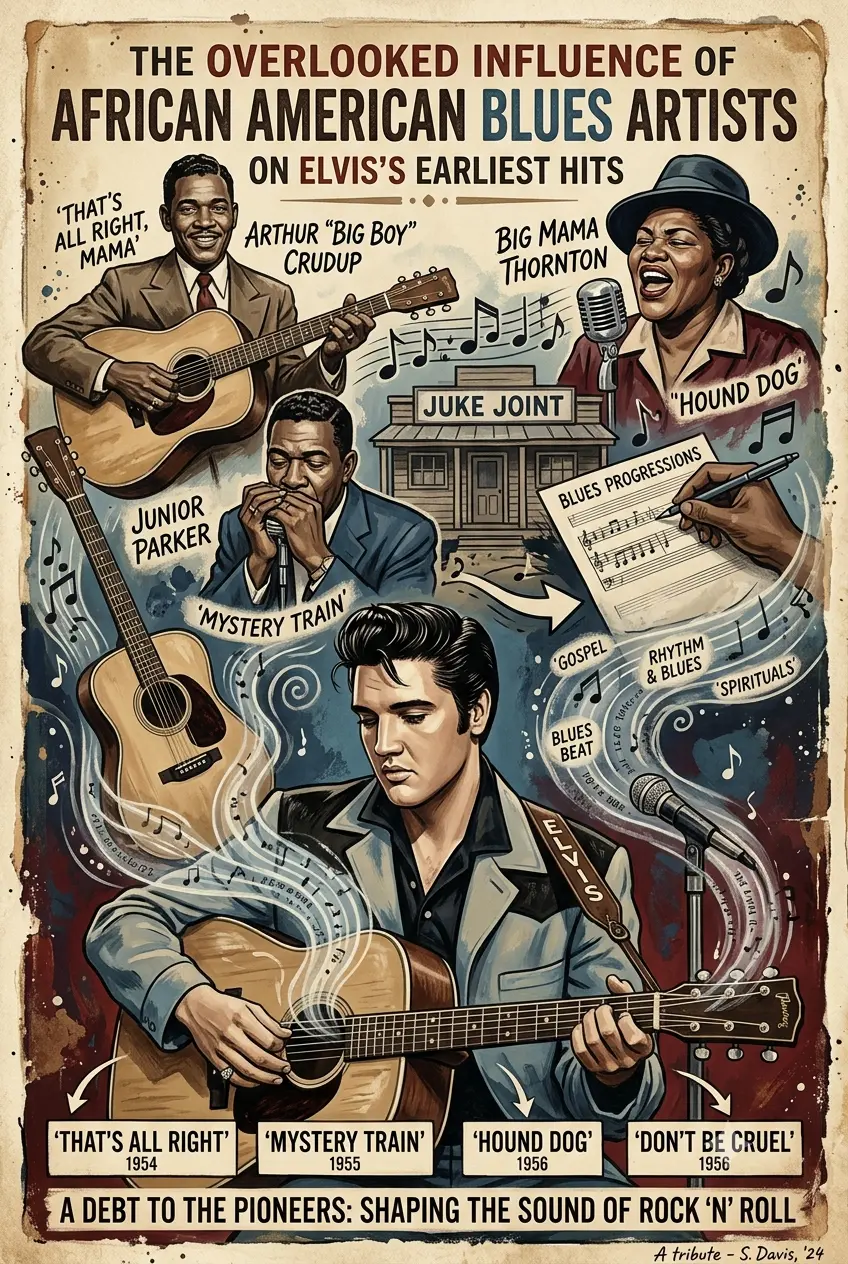
That song was “That’s All Right,” originally written and recorded in 1946 by Delta blues musician Arthur “Big Boy” Crudup. Phillips heard something in Elvis’s loose, energetic take on it and knew immediately it was the sound he’d been searching for. It became Elvis’s debut single, and while it didn’t chart nationally at first, it became the foundation his entire early career was built on.
Elvis never hid his admiration for Crudup. He reportedly said that if he’d had any ambition at all growing up, it was to become as good as Arthur Crudup, and he later recalled listening to Crudup play guitar back in Tupelo, hoping one day to capture even a fraction of that feeling in his own music. Elvis went on to record two more Crudup songs, “My Baby Left Me” and “So Glad You’re Mine,” both released not long after his RCA debut.
Decades later, in the early 1970s, Elvis reportedly told a friend backstage at Graceland that he wanted to open every show with “That’s All Right” for the rest of his career, saying plainly that without Crudup, he might not have had a career at all. He largely kept that promise until his final performances in 1977.
Big Mama Thornton and the Real Story Behind “Hound Dog”
“Hound Dog” is one of Elvis’s most recognizable songs, but it wasn’t written for him and it wasn’t performed by him first. The song was originally recorded by rhythm and blues singer Willie Mae “Big Mama” Thornton in 1952, four years before Elvis’s version turned it into a massive crossover hit.
Thornton’s original recording had real commercial success within the R&B market of its time, but nothing close to what Elvis’s version achieved once it topped the pop, country, and R&B charts simultaneously in 1956. That gap, between what Thornton earned from the song and what Elvis’s version generated, is one of the most frequently cited examples in discussions about how unevenly credit and money flowed between Black originators and white artists during this era of American music.
Junior Parker and “Mystery Train”
Another key figure in Elvis’s early catalog is Herman “Junior” Parker, a Clarksdale, Mississippi native who originally recorded “Mystery Train” before Elvis’s own Sun Records version turned it into one of his signature early songs. Parker’s original leaned more directly into blues tradition, while Elvis and his band reworked it with the faster, rockabilly-tinged energy that was becoming his trademark sound.
Parker’s contribution rarely gets mentioned outside of dedicated Elvis history circles, even though “Mystery Train” remains one of the most celebrated recordings of Presley’s entire Sun Records period.
Sister Rosetta Tharpe and the Gospel-Blues Connection
Not every influence came strictly from blues in the traditional sense. Gospel singer and guitarist Sister Rosetta Tharpe, sometimes called the Godmother of Rock and Roll, was another major figure in shaping Elvis’s sound, blending gospel themes with an electric guitar style and rhythmic drive that crossed easily into rhythm and blues territory.
Elvis grew up listening to Tharpe on a local Memphis radio station’s daily Black gospel programming block, and her influence sits alongside Crudup’s as one of the clearest through-lines connecting Elvis’s earliest recordings back to specific Black artists rather than a vague, general “influence” of the genre as a whole.
Why This Influence Gets Overlooked
Part of the reason these specific names get lost is structural, not accidental. Radio and the recording industry in the 1940s and early 1950s were largely segregated, with Black artists’ recordings often marketed narrowly as “race records” and denied the same mainstream airplay and promotion given to white artists, regardless of the music’s quality or originality.
That meant a song like Crudup’s original “That’s All Right” or Thornton’s original “Hound Dog” reached a smaller, more limited audience than Elvis’s later versions of the same material, even though the songs themselves and much of the musical innovation originated with the Black artists first. Over time, casual listeners came to associate the songs primarily with Elvis, simply because his versions were the ones that reached the largest audience.
Elvis’s Own Acknowledgment of These Artists
It’s worth noting that Elvis himself was fairly consistent about crediting his Black influences publicly, at a time when doing so wasn’t universally expected or even well received in parts of the country. He specifically named artists like Crudup and Fats Domino in interviews, and reportedly stated plainly that rock and roll existed long before he arrived on the scene.
Some of the artists he drew from returned that respect. B.B. King, who knew Elvis personally from their overlapping years in Memphis, argued that Elvis didn’t so much steal the music he grew up on as reinterpret it through his own voice. Little Richard, another artist frequently discussed alongside Elvis in these conversations, credited him with helping open doors for Black music to reach wider, previously unavailable audiences, even while acknowledging the complicated dynamics of who ultimately profited most.
A Complicated, Still-Debated Legacy
None of this erases a harder truth that historians and musicians continue to debate: white artists working in this era, Elvis very much included, generally achieved far greater commercial success and financial reward from blues-rooted material than the Black originators who created it first. Crudup, despite writing several of Elvis’s earliest and most important songs, spent much of his later life working outside the music industry entirely and only found modest financial stability again during the blues revival of the 1960s.
That imbalance is central to ongoing debates about cultural appropriation versus cultural appreciation, and reasonable people land in different places on it. Some point to the segregated media landscape of the era as clear evidence that credit and money were unfairly distributed along racial lines regardless of artistic merit. Others argue that framing the relationship purely as theft oversimplifies a genuinely complicated period of American music, one where Black publications and artists themselves often praised Elvis’s clear respect for the tradition he was drawing from, even as they recognized the unequal system surrounding it.
Both of those things can be true at once: Elvis’s earliest hits leaned directly and heavily on specific Black blues artists, and those same artists rarely received anything close to equivalent recognition or compensation for the material that helped build his career.
Why These Names Deserve to Be Remembered
Whatever position someone takes in that larger debate, one thing is hard to dispute: understanding Elvis’s earliest hits without knowing the names Arthur Crudup, Big Mama Thornton, Junior Parker, and Sister Rosetta Tharpe means missing a huge part of the actual story. These weren’t distant, vague influences. They were specific people whose songs, style, and vocal choices were directly reworked into some of the most famous recordings in American music history.
FAQ
Who wrote Elvis’s first single, “That’s All Right”? The song was written and originally recorded in 1946 by Delta blues musician Arthur “Big Boy” Crudup. Elvis’s 1954 version became his debut single at Sun Records.
Did Elvis write “Hound Dog”? No. “Hound Dog” was originally written for and recorded by rhythm and blues singer Big Mama Thornton in 1952, four years before Elvis’s version became a massive crossover hit.
Who originally recorded “Mystery Train”? “Mystery Train” was originally recorded by Herman “Junior” Parker before Elvis and his band reworked it into a faster, rockabilly-influenced version at Sun Records.
Did Elvis publicly credit his Black musical influences? Yes. Elvis frequently named artists like Arthur Crudup and Fats Domino in interviews and stated that rock and roll existed before he became involved in it.
Was Elvis’s success considered cultural appropriation at the time? Views were mixed even then. Some Black publications in the 1950s praised Elvis’s respect for Black musical traditions, while modern critics point to the unequal financial and career outcomes between Elvis and the original Black artists as clear evidence of a deeper, unresolved imbalance.
Did any of these original artists benefit financially from Elvis’s success? Only modestly, in most cases. Artists like Arthur Crudup saw limited financial benefit from Elvis’s recordings of his songs and largely worked outside the music industry for years afterward, only regaining some visibility during the blues revival of the 1960s.
Editor’s Opinion
honestly the crudup story gets me every time, the guy basically gave elvis his whole career with one song and still ended up driving migrant workers for a living later on. thats not a footnote thats kind of messed up if u think about it. i dont think elvis was some evil guy stealing on purpose, he clearly loved and respected these artists, but the system around him just wasnt fair to the ppl who made the music first. both things are true at once i guess, he was a fan AND he benefited way more then he shouldve compared to guys like crudup.