Gospel music shaped Elvis Presley long before rock and roll ever entered the picture. The vocal swoops, the dramatic whisper-to-wail shifts, even the hip shaking and leg movements that made him famous, almost none of it started on a rock stage. It started in a small Pentecostal church in Tupelo, Mississippi, and in the packed pews of Memphis auditoriums where teenage Elvis sat glued to gospel quartets years before anyone knew his name.
This isn’t a footnote to his career. Gospel was arguably the deepest musical influence Elvis ever had, and understanding it explains a lot about why he performed the way he did.
Quick Answer
Gospel music shaped Elvis Presley’s vocal technique and stage presence by exposing him, from early childhood, to the emotional vocal style, dramatic dynamics, and full-body physicality of Pentecostal worship and Southern gospel quartets like the Statesmen and the Blackwood Brothers. Those influences directly shaped his singing style, his stage movement, and even earned him his only competitive Grammy Awards.
Church Was His First Stage
Elvis was born in Tupelo, Mississippi, in 1935, into a family that attended the First Assembly of God church regularly. His parents, Vernon and Gladys, were devout members of a denomination known for enthusiastic, hands-in-the-air worship rather than quiet, restrained hymn singing.
Gladys Presley once described her son as a toddler sliding off her lap in the middle of a service and running down the aisle to stand beneath the choir, straining to sing along even though he was too young to know the words. That image says a lot. Long before Elvis knew what a record contract was, he already knew what it felt like to be pulled toward music happening live in front of him.
The services themselves were far from quiet. Assembly of God worship in that era involved hand-clapping, foot-stomping, and what one account describes as spirit-filled singing that had little in common with mainline Protestant hymn traditions. Elvis later remembered the music starting up and the whole congregation dancing around the room.
That was his earliest classroom for both singing and performing, and the two were never really separate for him.
The All-Night Gospel Singings That Changed Everything
As Elvis got older, his gospel education moved beyond his own church. He and his family regularly attended the All-Night Gospel Singings at Ellis Auditorium in downtown Memphis, marathon events that brought together some of the biggest names in Southern gospel on a single bill.
These shows exposed Elvis to a huge range of styles in one sitting, from the dignified, older shape-note singing of groups like the Speer Family, to the flashy showmanship of newer acts. Two groups stood out above the rest for Elvis: the Blackwood Brothers, who were his mother’s favorites, and the Statesmen Quartet, whose energetic performances captivated both Elvis and his father.
Jake Hess, the Statesmen’s lead singer, became a personal hero. Elvis openly credited Hess as a major vocal influence on his own singing, and the two developed a real relationship over the years. Hess later recalled a young Elvis showing up at Statesmen concerts even in Tupelo, asking earnest questions like how records got made. Decades later, Hess sang at Elvis’s funeral in 1978.
Elvis wasn’t just watching from the crowd, either. According to people who knew him at the time, he was occasionally invited up on stage during Statesmen shows to sing lead on a song or two, getting a direct, hands-on feel for performing in front of a live gospel audience years before he ever stepped into Sun Studio.
Where the Voice Came From
Listen closely to Elvis’s early recordings and the gospel fingerprints are everywhere. The dramatic dynamic shifts, the way he could drop to a near-whisper and then swell into a full-throated wail within a single phrase, trace directly back to Southern gospel vocal tradition.
Several specific techniques carried straight over from gospel into his rock and roll and ballad work:
- Melismatic phrasing – stretching a single syllable across several notes, a hallmark of gospel vocal ornamentation
- Dramatic dynamic swings – moving from soft, intimate delivery to full power within a phrase, rather than staying at one volume
- Call-and-response instincts – a structure borrowed directly from church singing, where a lead voice and a group trade phrases back and forth
- Emotional over-delivery on ballads – treating a secular love song with the same reverence and intensity gospel singers brought to a hymn
Elvis reportedly said he knew nearly every gospel song ever written, and that wasn’t an idle boast. He’d absorbed the genre so thoroughly by his teenage years that its vocal language became his default setting, whether he was singing about heartbreak or singing about the Holy Spirit.
Stage Presence Born in the Pews
The physical side of Elvis’s performances has a gospel origin story too, and it’s a specific one. Statesmen bass singer James “Big Chief” Wetherington was known for shaking his leg while he performed, a signature bit of stage business that predates Elvis’s own leg-shaking by years. Elvis reportedly idolized and imitated exactly that move.
That detail matters, because it reframes one of the most controversial parts of Elvis’s early career. The hip and leg movements that scandalized parents and delighted teenagers on television in the mid-1950s weren’t invented from nothing. They were, at least in part, borrowed straight from a gospel bass singer performing in front of a churchgoing Memphis crowd.
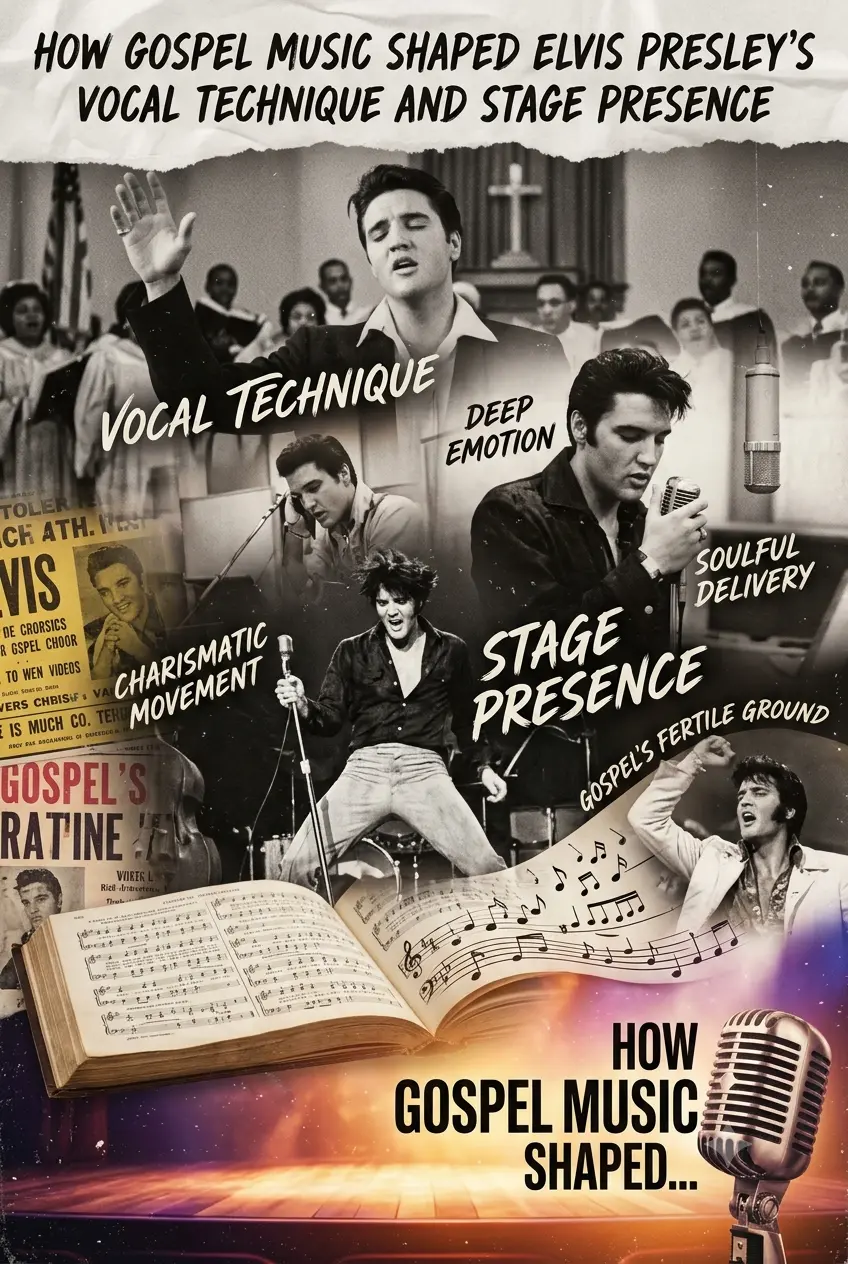
More broadly, gospel quartets of that era were built around showmanship as much as vocal skill. Performers moved, reacted to each other, and physically embodied the emotion of the song rather than standing still behind a microphone. Elvis grew up watching that model of performance for years before he ever had an audience of his own, and it shows in how physically expressive he remained on stage for his entire career.
Gospel Never Left, Even at the Peak of Rock Stardom
Unlike a lot of childhood influences that fade once someone becomes famous, gospel stayed central to Elvis’s musical identity for his entire life. He recorded multiple gospel albums, and gospel music delivered the only competitive Grammy Awards he ever won, out of a career that produced more commercial success than almost anyone else in the industry.
His 1967 album “How Great Thou Art” won a Grammy, and by most accounts, his live performances of the title track were even more powerful than the studio version. Backstage and after hours, Elvis would frequently gather with friends and bandmates to sing gospel songs for hours, treating it less like work and more like something closer to worship.
Later in his career, Elvis brought that world directly into his touring band, hiring JD Sumner and the Stamps Quartet as his backing vocalists for much of the 1970s. Songs like “Why Me Lord” and “Crying in the Chapel” carried that gospel DNA straight into his mainstream setlists, right alongside “Suspicious Minds” and “Hound Dog.”
Why This Still Matters
It’s easy to remember Elvis purely as a rock and roll rebel, all hip shakes and pink Cadillacs. But the raw materials of his singing style and his stage presence were largely built years earlier, in church pews and packed gospel auditoriums, long before rock and roll existed as a genre.
Artists as varied as Bob Dylan, Bruce Springsteen, and U2 have pointed to Elvis’s gospel recordings as a meaningful influence on their own work. That’s a fairly direct line running from a Pentecostal church in Tupelo, through a teenage Elvis sitting in the crowd at Ellis Auditorium, all the way to some of the most important songwriters of the following decades.
FAQ
What church did Elvis Presley grow up attending? Elvis grew up attending the First Assembly of God church in Tupelo, Mississippi, and later continued attending Assembly of God services after his family moved to Memphis.
Which gospel groups influenced Elvis the most? The Statesmen Quartet and the Blackwood Brothers were his two biggest influences, along with Statesmen lead singer Jake Hess, whom Elvis specifically named as a major vocal influence.
Did Elvis Presley win any Grammy Awards? Yes, and notably, all of his competitive Grammy wins during his lifetime were for gospel recordings, including his 1967 album “How Great Thou Art.”
Where did Elvis’s famous leg-shaking come from? Historians point to Statesmen Quartet bass singer James “Big Chief” Wetherington, whose own leg-shaking stage habit is widely believed to have directly inspired the young Elvis.
Did Elvis keep performing gospel music after he became a rock star? Yes, throughout his career. He recorded several gospel albums, frequently sang gospel privately with friends, and hired gospel group JD Sumner and the Stamps as his backing vocalists during his 1970s touring years.
How did gospel music affect Elvis’s singing technique specifically? Gospel shaped his use of melisma, his dramatic shifts between soft and powerful delivery, and his call-and-response instincts, all techniques rooted in Southern gospel and Pentecostal worship traditions.
Editor’s Opinion
honestly i didnt know how deep the gospel connection went until i looked into it, i always just thought of elvis as the rock and roll hip shaking guy. but nah, turns out that whole leg thing came from a gospel bass singer called big chief lol, that alone kinda blew my mind. i think ppl forget that elvis basically only won grammys for gospel, not for hound dog or jailhouse rock, thats wild when you think about it. makes total sense once u know his whole childhood was built around church singing though.