Why Elvis Presley never toured outside North America is one of the strangest mysteries in music history. He was arguably the most famous entertainer on the planet, with fans in nearly every country, yet he never once performed a full concert overseas. Not in London. Not in Tokyo. Not in Sydney. Nowhere outside the United States and a brief handful of shows in Canada.
For an artist who sold hundreds of millions of records worldwide, that gap is almost impossible to believe. This article breaks down what actually kept Elvis off international stages, and why the real answer has more to do with one man’s hidden past than anything about Elvis himself.
The Basic Facts
Over his career, Elvis performed more than 1,600 shows across over 240 cities. Every single one of them took place in the United States, aside from three concerts in Canada in 1957.
Those Canadian shows don’t really count as “international” travel in the way people usually mean it. At the time, Americans could cross the Canadian border with minimal documentation, so the trip didn’t require the kind of paperwork a true overseas tour would have needed.
Outside of that, Elvis never performed live in Europe, Asia, Australia, or anywhere else, despite decades of demand from fans around the world.
It Wasn’t Fear of Flying
One theory that gets repeated online is that Elvis simply had a fear of flying and avoided long international trips because of it. This explanation doesn’t hold up well.
Elvis flew constantly throughout his career, including piloting personal jets and traveling frequently for films, appearances, and personal trips. Flying itself clearly wasn’t the obstacle. Something else was keeping him grounded when it came to international shows specifically.
The Real Reason: Colonel Tom Parker
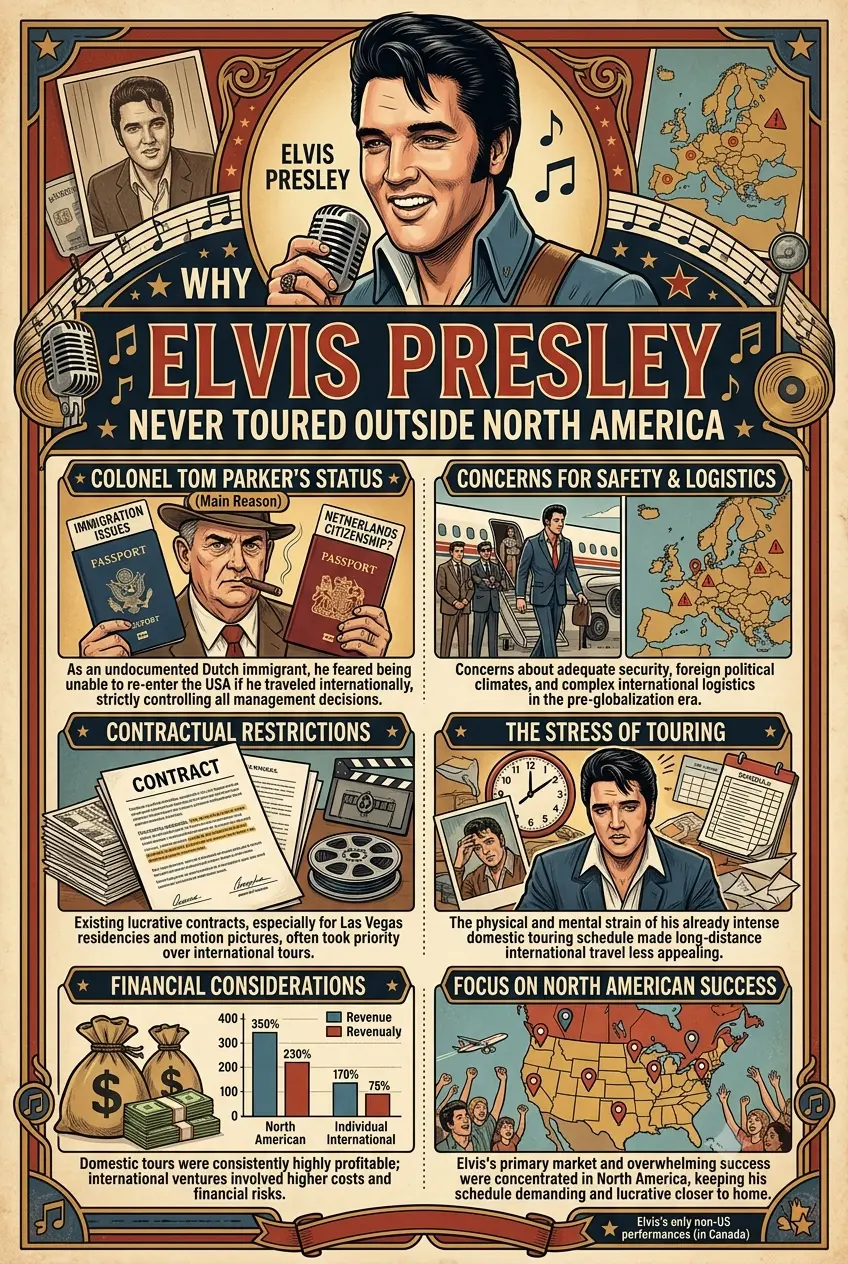
The most widely accepted explanation centers entirely on Elvis’s manager, Colonel Tom Parker. Parker controlled nearly every part of Elvis’s career, from his film contracts to his Las Vegas residencies, and he took an unusually large cut of Elvis’s earnings, reportedly around 50 percent.
According to many biographers and people close to Elvis, Parker was the one who consistently blocked international tour plans, even when massive offers came in from overseas promoters.
Parker’s Hidden Immigration Status
The core issue traces back to who Colonel Parker actually was. His real name wasn’t Tom Parker at all. He was born Andreas Cornelis van Kuijk in the Netherlands and entered the United States without proper documentation decades before he ever met Elvis.
Parker built an entire public identity around being “Colonel Tom Parker,” an American figure with a fabricated backstory, while quietly avoiding any situation that might expose his actual immigration history.
Many researchers believe Parker feared that leaving the country, even briefly for a tour, could have triggered serious problems reentering the United States. Whether that risk was based on a lack of valid documentation, an uncertain legal status, or simply the fear of drawing official attention to his background, the outcome was the same: Parker avoided international travel entirely for the rest of his life.
Elvis Reportedly Wanted to Go
This wasn’t a case of Elvis having zero interest in performing abroad. According to Jerry Schilling, a longtime member of Elvis’s inner circle, Elvis specifically wanted to tour overseas, including trips to Australia and Japan.
When Elvis brought these plans to Parker, the response was firm resistance. Parker reportedly told Elvis that if he pursued an international tour, he would do it without him as manager. At one point, Elvis apparently tried to fire Parker altogether and move forward with international dates on his own.
According to accounts from people close to him, that attempt didn’t go smoothly. Promoters and industry contacts were reportedly hesitant to get involved once word spread that Parker was no longer directly involved, worried about how it might affect their relationship with him down the line.
The Excuses Parker Gave Publicly
Rather than explain the real issue, Parker offered a long list of practical-sounding reasons whenever international tours came up. He pointed to the cost of shipping equipment overseas, complicated insurance requirements, security concerns, and language barriers as reasons a world tour simply wasn’t realistic.
On paper, these explanations sounded reasonable. In reality, they didn’t match the offers being made. As late as the mid-1970s, promoters from South America and even officials in Saudi Arabia were reportedly offering enormous sums of money for Elvis to perform, and Parker turned them down regardless of the price.
If cost or logistics had truly been the obstacle, offers of that size should have solved the problem. They didn’t change anything, which is a big part of why so many researchers point back to Parker’s personal situation as the real driving factor.
A Competing Theory Worth Mentioning
Not every historian agrees that Parker’s immigration status was the entire explanation. Some researchers who have dug into Dutch government records claim Parker actually retained his original citizenship throughout his life and could likely have obtained a passport if he had genuinely wanted one.
Under this view, the full picture is more complicated than a single missing document. It may have involved a combination of Parker’s need for total control over Elvis’s schedule, his preference for guaranteed income from Las Vegas residencies and film deals, and a general unwillingness to take on the added risk and expense of large-scale international logistics, on top of whatever personal concerns he had about his background.
Either way, the common thread across nearly every version of this story is the same: the decision came from Parker, not from Elvis.
What This Meant for Elvis’s Career
The impact of never touring internationally was significant. While contemporaries like The Beatles built massive global followings through extensive overseas tours, Elvis’s live performances stayed confined entirely to American stages and casino showrooms, especially during his later Las Vegas years.
International fans were left with records, films, and television broadcasts as their only real connection to him. For millions of people who admired Elvis from overseas, the chance to see him perform live simply never came, no matter how much demand existed or how much money promoters were willing to offer.
The Offers Elvis Turned Down (Without Ever Knowing)
One of the more frustrating details in this story is how many of the biggest international offers may never have fully reached Elvis in a serious way. Parker often handled negotiations directly, meaning he could reject offers, downplay their value, or simply avoid bringing them up before Elvis ever had a real chance to weigh in.
This matters because it changes the story from “Elvis chose not to tour” to something closer to “Elvis rarely got the full picture.” Several accounts describe Parker fielding enormous offers from promoters in Japan, Australia, and parts of Europe over the years, often turning them down quickly and quietly.
For fans overseas hoping to see Elvis live, this meant the door was often closed before it ever really opened, without them or Elvis fully realizing just how close it may have come to happening.
Why This Story Still Resonates
Elvis Presley never touring outside North America remains one of the more frustrating footnotes of his career, especially for fans who see it as a missed opportunity that had nothing to do with Elvis’s own wishes. He reportedly wanted to perform overseas. The demand was clearly there. The only consistent obstacle was the man controlling his career from behind the scenes.
It’s a reminder of just how much influence Colonel Parker held over even the biggest decisions in Elvis’s professional life, right down to something as basic as where he was allowed to perform.
Editor’s Opinion
this one honestly makes me kinda mad ngl. elvis WANTED to tour overseas and got told no just becuase his manager had some sketchy immigration secret he didnt want exposed?? thats wild. fans all over the world never got to see him live becuase of one guys personal issue, not becuase elvis didnt care. kinda sad when you think about it, hes probably the most famous performer ever and so many ppl never got the chance.
Frequently Asked Questions
Did Elvis Presley ever perform outside the United States? He performed three shows in Canada in 1957. Outside of that, every one of his more than 1,600 concerts took place within the United States.
Why didn’t Elvis Presley tour internationally? The most widely accepted reason is that his manager, Colonel Tom Parker, avoided international travel due to concerns about his undocumented immigration status.
Was Elvis afraid of flying? No. Elvis flew regularly throughout his career, including piloting his own private jets, so fear of flying wasn’t the reason he avoided overseas tours.
Did Elvis want to perform overseas? Yes. According to people close to him, Elvis specifically expressed interest in touring Australia and Japan, but his manager blocked those plans.
What excuses did Colonel Parker give for avoiding international tours? He publicly cited costs, security concerns, insurance issues, and logistical complications, even when huge offers came in from overseas promoters.
Was Colonel Parker really an undocumented immigrant? Most biographers agree Parker entered the United States without proper documentation and never formally settled his citizenship status, though some researchers dispute parts of this story.
Did Elvis ever try to tour internationally without Parker? Reportedly, yes. Elvis attempted to move forward with plans on his own after a disagreement with Parker, but the effort didn’t succeed.
How much control did Colonel Parker have over Elvis’s career? Parker managed nearly every aspect of Elvis’s professional life, including film deals, tour schedules, and Las Vegas residencies, while taking around 50 percent of his earnings.
One Comment
Leave a ReplyOne Ping
Pingback:Parkes Elvis Festival: How Australia Built the Southern Graceland