Lamar Fike Elvis Memphis Mafia — few quotes in rock and roll history cut as deep as this one. Pulled from Alanna Nash’s landmark oral history Elvis and the Memphis Mafia, Fike’s reflection on what it meant to live inside Elvis Presley’s world — and then try to survive without it — is one of the most honest things anyone in that circle ever said out loud.
It deserves to be read slowly.
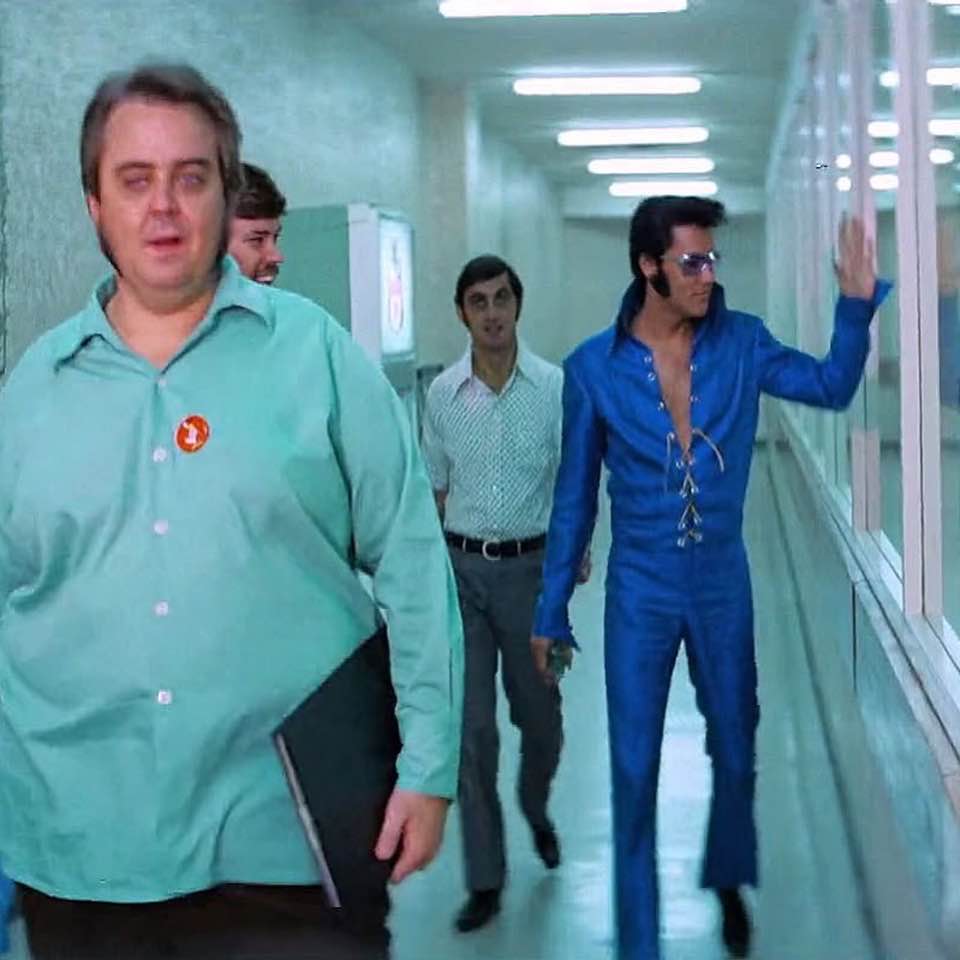
“We All Became One Bundle”
Fike opens with something almost funny, then immediately turns it into something profound.
His cousin once told him he played guitar like Elvis. Fike’s response: “That’s because he taught me.” He points out that David Stanley walks like Elvis, talks like Elvis, carries himself like Elvis — and doesn’t even realize he’s doing it. The men who spent years living inside Presley’s gravitational pull absorbed him so completely that pieces of Elvis became pieces of themselves.
“We all became one bundle,” Fike said, “wrapped up with the same string.”
And then, with the kind of dry humor that only comes from someone who has fully accepted a hard truth: “I know that when I die, Elvis will still get top billing. Like, ‘Former Elvis Employee Dies.'”
It lands as a joke. It also happens to be exactly true.
Buying Fifty Pounds of Sugar
The detail that hits hardest isn’t about grief or fame or loss. It’s about grocery shopping.
Fike describes going to the store and buying fifty pounds of sugar when he only needs five. His wife asks what he’s doing. His answer: “I’m doing what I’ve always done.”
What he’d always done, for years, was shop for a small army. A group of men who lived together, traveled together, and existed as a unit. That unit was built around one person, and when that person was gone, the habits remained — the instincts, the rhythms, the scale of everything.
You can’t just switch that off. The muscle memory of a life lived communally doesn’t disappear because the reason for it does.

The Knapsack of Insecurities
Fike is equally clear-eyed about the emotional cost.
He says he doesn’t make friends easily anymore — because after everything, he genuinely doesn’t know where people are coming from. He notes that Marty Lacker is suspicious of everyone. The trust that should come naturally doesn’t, because it was broken too many times, in too many ways, by circumstances none of them saw coming.
“We carry our insecurities around like a knapsack,” he said.
That image is quietly devastating. Not a wound. Not a scar. A knapsack — something you strap on every morning and take with you wherever you go, something you’ve gotten so used to carrying that you barely notice the weight anymore.
What He Left Behind
Fike ends where Elvis’s story always ends — not with the music, but with the people.
“He lives through his music, but he also lives through us.”
That line contains everything. The records are the legacy the world sees. The Memphis Mafia is the legacy only they carry — the bought habits, the borrowed gestures, the fifty pounds of sugar, the knapsack full of everything nobody else can see.
For better or worse, as Fike put it, they are what Elvis left behind.
And they’ve been carrying it ever since.