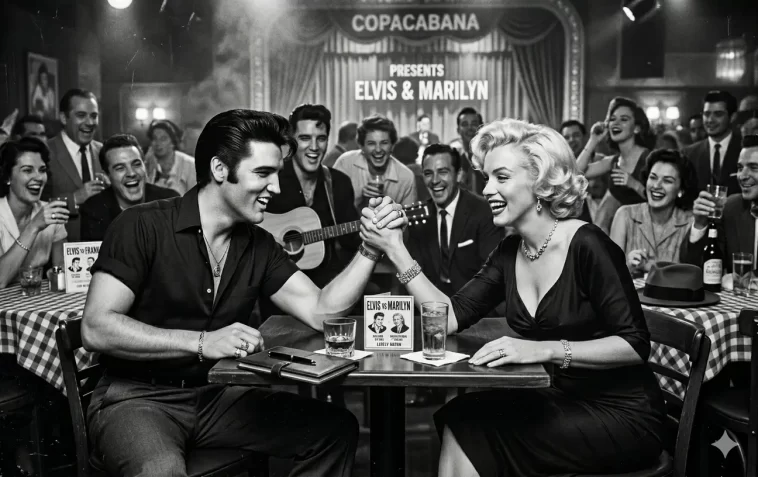
Elvis Presley vs Marilyn Monroe — two names that don’t just represent music and film. They represent something much bigger. They are, arguably, the two most iconic figures in American popular culture of the twentieth century.
Both were born poor. Both rose to a level of fame that was almost incomprehensible. Both struggled deeply in private while the world adored them in public. And both died tragically young, leaving behind legacies that have only grown larger with every passing decade.
This isn’t a straightforward comparison of talent against talent. It’s a study in what fame means, what it costs, and what it leaves behind.
Two Lives, Two American Stories
Elvis Presley: Born from Nothing, Became Everything
Elvis Aaron Presley was born on January 8, 1935 in a two-room shotgun house in Tupelo, Mississippi. His family was dirt poor. His twin brother Jesse was stillborn. He grew up in a deeply religious household where gospel music was the emotional center of life.
When Elvis walked into Sun Studio in Memphis in 1954, he was a 19-year-old kid who drove a truck for a living. Within two years he was the most famous person in America. His blend of country, gospel, and rhythm and blues created rock and roll as the world knows it — and his physical performances redefined what a pop star could be.
By the time he died in August 1977 at the age of 42, he had sold hundreds of millions of records, made 31 films, and performed for millions of people across the world. He never toured outside North America, yet he was globally adored.
Marilyn Monroe: The Girl the World Couldn’t Stop Watching
Norma Jeane Mortenson was born on June 1, 1926 in Los Angeles, California. Her childhood was marked by instability — her mother was institutionalized, she spent years in foster care and an orphanage, and she married for the first time at just 16 to escape the system.
She became Marilyn Monroe through sheer determination, reinventing herself completely. By the early 1950s she was the most photographed woman on earth. Her performances in Gentlemen Prefer Blondes (1953), Some Like It Hot (1959), and Bus Stop (1956) showed a comedic and dramatic talent that was consistently underestimated during her lifetime.
She died in August 1962 at the age of 36, from an overdose of barbiturates. The circumstances of her death have been debated ever since.
What They Had in Common
Before the comparison, it’s worth pausing on the parallels — because they are remarkable.
- Both were born into poverty and rose to the very peak of fame
- Both were working class Americans who became global symbols
- Both were considered sex symbols in ways that complicated how seriously they were taken
- Both had deeply troubled private lives hidden behind carefully managed public images
- Both struggled with prescription drug dependency
- Both died young — Elvis at 42, Marilyn at 36
- Both became even more iconic after death than they were in life
- Both are still among the most recognizable human faces on the planet today
The similarities are not coincidental. They point to something specific about mid-century American fame — the way it elevated people to impossible heights and then offered them very little support once they got there.
Head-to-Head: The Key Categories
Fame and Public Presence
In the 1950s, no two people in America were more famous than Elvis Presley and Marilyn Monroe. They occupied a different tier of celebrity than anyone else — not just famous, but mythological.
Elvis was a phenomenon from his very first television appearances. His Ed Sullivan Show performances in 1956 drew audiences of 60 million people. Teenagers screamed, parents panicked, and the media couldn’t get enough. His face sold magazines, his records sold in the millions, and his image was everywhere.
Marilyn had a different kind of presence — more glamorous, more carefully constructed, and in many ways more enduring. Her image from The Seven Year Itch (1955) — standing over the subway grate in a white dress — is one of the most reproduced photographs in history. Andy Warhol’s silkscreen prints of her face became some of the most famous artworks of the twentieth century.
If Elvis was the sound of a generation, Marilyn was the image of one. Both forms of presence were overwhelming in their own way.
Talent and Craft
This is where the comparison gets genuinely interesting.
Elvis Presley had one of the most naturally gifted voices in popular music history. His range, his emotional depth, his ability to move between tender vulnerability and explosive power — all of it was largely instinctive. He didn’t read music. He absorbed it. Songs like Unchained Melody, If I Can Dream, and American Trilogy show a vocalist capable of genuine grandeur.
Marilyn Monroe was a far more skilled actress than she was ever given credit for. She studied seriously at the Actors Studio in New York under Lee Strasberg — the home of Method acting. Her comedic timing in Some Like It Hot is considered by many film critics to be among the finest in Hollywood history. Billy Wilder, who directed her twice and found her exhausting to work with, still called her the greatest comedic actress he had ever seen.
She also sang. Her breathy, intimate delivery of Happy Birthday, Mr. President to John F. Kennedy in 1962 is one of the most famous musical performances in American history — brief, charged, unforgettable.
Both were artists who were simultaneously celebrated and underestimated. Both were seen primarily as physical presences when they were, in fact, deeply talented performers.
Cultural Impact
Elvis changed the sound of the world. Before him, the music industry was largely segregated — Black music for Black audiences, white music for white audiences. Elvis brought rhythm and blues, gospel, and raw energy to mainstream white America in a way that was both culturally significant and commercially explosive. He created the template for the rock star. Every performer who came after him — from The Beatles to Bruce Springsteen to Beyoncé — stands on ground he broke.
Marilyn changed the image of the world. She redefined beauty standards, female sexuality, and what it meant to be a woman in public life. She challenged the idea that a woman had to choose between being desirable and being intelligent — and she paid a heavy price for refusing to stay in the box Hollywood built for her. Her founding of Marilyn Monroe Productions in 1954, at a time when female stars had virtually no control over their careers, was a genuinely radical act.
Both left permanent marks on American culture. Elvis shaped how people listened. Marilyn shaped how people looked and were looked at.
The Image and the Icon
Few people in history have become visual icons in the way that Elvis and Marilyn have.
Elvis’s image — the pompadour, the curled lip, the jumpsuit, the sunglasses — is instantly recognizable in every corner of the world. He is impersonated more than any other figure in history. There are estimated to be over 80,000 Elvis impersonators active worldwide. His face appears on stamps, murals, merchandise, and tattoos across every continent.
Marilyn’s image is perhaps even more universally reproduced. Warhol’s prints. The white dress. The red lips. The platinum hair. She has appeared on more magazine covers posthumously than most living celebrities manage in a lifetime. Her face is a shorthand for glamour, vulnerability, and the price of fame simultaneously.
If anything, both of their images became more powerful after death — stripped of the complicated, struggling human beings behind them and transformed into pure symbols.
The Private Person Behind the Icon
Here is where both stories become genuinely heartbreaking.
Elvis spent his final years increasingly isolated at Graceland, surrounded by a tight circle of employees and yes-men known as the Memphis Mafia. His dependency on prescription medications — sleeping pills, painkillers, amphetamines — was an open secret managed by compliant doctors. He gained weight, struggled on stage, and was clearly in decline. The man who had once been the most electrifying performer on earth died alone on a bathroom floor.
Marilyn spent her short life searching for stability she never found. Three marriages — to James Dougherty, Joe DiMaggio, and Arthur Miller — all ended in pain. Her relationships with powerful men, including President John F. Kennedy and his brother Robert, were kept carefully hidden. Despite her global fame, she described herself as deeply lonely. She died alone in her Brentwood home at 36.
Both stories are painful reminders that fame, at a certain level, can become a kind of prison. The bigger the icon, the harder it becomes to be seen as a human being.
Legacy and Staying Power
Decades after their deaths, both remain extraordinarily relevant.
Elvis Presley’s estate generates tens of millions of dollars per year. Graceland in Memphis attracts over 600,000 visitors annually. His music streams billions of times. The 2022 Baz Luhrmann biopic Elvis — starring Austin Butler — grossed over $287 million worldwide and introduced him to an entirely new generation of fans.
Marilyn Monroe’s estate is similarly active. Her image is licensed constantly for advertising, fashion, and art. The 2022 film Blonde — starring Ana de Armas — brought her story to a new generation, though with considerable controversy. Her original Happy Birthday, Mr. President dress sold at auction in 2016 for $4.8 million.
Both of them are, in a very real sense, more famous now than most living celebrities. That kind of posthumous relevance is extraordinarily rare and speaks to how deeply they embedded themselves into the fabric of American culture.
Side-by-Side Comparison
| Category | Elvis Presley | Marilyn Monroe |
|---|---|---|
| Born | January 8, 1935 | June 1, 1926 |
| Died | August 16, 1977 (age 42) | August 4, 1962 (age 36) |
| Field | Music, film | Film, performance |
| Peak fame | 1956–1977 | 1953–1962 |
| Major works | Hound Dog, Jailhouse Rock, Unchained Melody | Some Like It Hot, Gentlemen Prefer Blondes, The Misfits |
| Awards | 3 Grammy Awards | Golden Globe Award (1960) |
| Estimated records sold | 500 million+ | N/A |
| Films made | 31 | 29 |
| Marriages | 1 (Priscilla Presley) | 3 |
| Andy Warhol subject | Yes | Yes |
Who Left the Bigger Legacy?
This is genuinely difficult — and perhaps the wrong question.
Elvis left a bigger legacy in music. There is no popular music as we know it without him. The entire lineage of rock, pop, soul, and everything that followed traces back in some way to what he started at Sun Studio in 1954.
Marilyn left a bigger legacy in image and culture. She became the defining female icon of the twentieth century — a symbol of desire, vulnerability, and the impossible demands placed on women by fame and by men.
What they share is more significant than what separates them. Both were extraordinary talents who were never fully understood or respected while they were alive. Both were products of the American Dream in its most extreme form — the belief that anyone, no matter how poor or how broken their beginning, could become the most famous person in the world.
And both paid for that dream with everything they had.
FAQ: Elvis Presley vs Marilyn Monroe
Q: Did Elvis Presley and Marilyn Monroe ever meet? There is no confirmed documented meeting between Elvis and Marilyn, despite the fact that they were both at the peak of their fame during the same period — the mid-1950s to early 1960s. They moved in overlapping Hollywood circles, but no verified encounter has been recorded.
Q: Who was more famous during their lifetime — Elvis or Marilyn? Both were at the absolute peak of global celebrity during their active years, making a direct comparison almost impossible. Elvis dominated music and youth culture; Marilyn dominated film and visual culture. In the late 1950s and early 1960s, they were arguably the two most photographed and written-about people in the world.
Q: Who has the more valuable estate today? Elvis Presley’s estate is generally considered more valuable, generating significant annual revenue through Graceland tourism, music licensing, merchandise, and media projects. Marilyn Monroe’s estate also generates considerable income through image licensing, but Elvis’s operation is larger and more diversified.
Q: Were Elvis and Marilyn similar as people? More than most people realize. Both came from poverty and difficult childhoods. Both struggled with prescription drug dependency. Both were surrounded by people who profited from them rather than protected them. Both felt deeply misunderstood despite — or perhaps because of — their extraordinary fame.
Q: What made Marilyn Monroe a good actress? Marilyn studied Method acting seriously at the Actors Studio in New York. Her comedic timing was exceptional — director Billy Wilder called her the greatest comedic actress he ever worked with. Her performance in Some Like It Hot (1959) is considered a masterclass in physical comedy and character work. She was far more technically skilled than her glamorous image suggested.
Q: Why did both Elvis and Marilyn die so young? Both struggled with prescription drug dependency in an era when celebrity was managed very differently than today. Neither had access to meaningful mental health support. Both were surrounded by people who enabled rather than helped them. The extreme nature of their fame created enormous personal pressures that neither was equipped to handle alone.
Q: Which of them has been portrayed in film more often? Both have been portrayed numerous times, but Marilyn Monroe has perhaps been depicted more frequently in film and television biopics — from My Week with Marilyn (2011) to Blonde (2022). Elvis was famously portrayed by Austin Butler in Baz Luhrmann’s Elvis (2022), which became one of the most successful music biopics ever made.
Q: Are they both considered American cultural symbols? Without question. Elvis and Marilyn are probably the two most universally recognizable American cultural icons of the twentieth century — symbols not just of talent and beauty, but of the American experience itself, including both its extraordinary promise and its profound costs.
Elvis Presley and Marilyn Monroe. Two people from nothing who became everything. Two lives that burned so brightly they left marks on the world that time simply cannot erase.