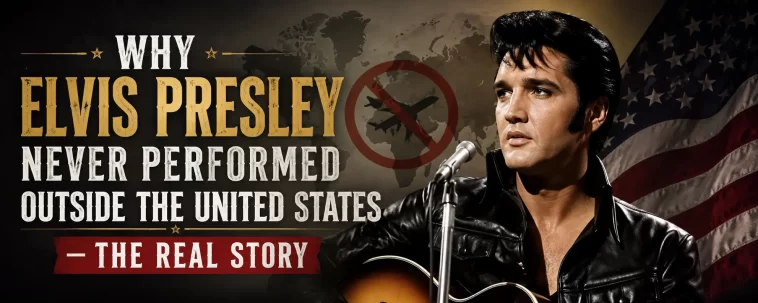
He owned a private jet. He had fans in every corner of the world. Promoters from Europe, South America, Australia, and even the Middle East were lining up with suitcases full of money, begging for just one tour, just one show. Elvis Presley was the most famous entertainer on the planet — and he never once performed outside the United States.
Not in London. Not in Tokyo. Not in Paris. Not in Sydney.
In his entire career, Elvis played exactly three concerts outside American soil — all of them in Canada, all in 1957, all before he had even reached the peak of his fame. After that, nothing. The rest of the world got records, posters, and movies. They never got the real thing.
For decades, fans and music historians have asked the same question: why? The answer, it turns out, is one of the most fascinating, troubling, and deeply human stories in the history of popular music. And it starts not with Elvis — but with the mysterious man who controlled his life.
The Man Behind the Curtain
To understand why Elvis never toured internationally, you have to understand Colonel Tom Parker. And to understand Colonel Tom Parker, you have to know who he really was — because almost everything he told people about himself was a lie.
Parker claimed to have been born in Huntington, West Virginia, sometime in the early 1900s. He told stories about running away from home to join the circus, drifting through carnivals, and eventually working his way up through the entertainment business with nothing but street smarts and sheer determination. It was a great American story. It was almost entirely fiction.
His real name was Andreas Cornelius van Kuijk. He was born in Breda, a small city in the Netherlands, on June 26, 1909. As a young man, he made his way to the United States — not through any official immigration channel, but as a stowaway on a ship. He slipped into the country without papers, without a passport, and without any legal right to be there. He never left.
Over the following decades, Parker built a career in showbusiness, working carnivals and fairs before transitioning into music promotion and artist management. He was brilliant at it — aggressive, cunning, and completely without sentimentality when it came to making money. He acquired the honorary title of “Colonel” in 1948 when Louisiana Governor Jimmie Davis awarded it to him after Parker helped with his election campaign. The title stuck. It gave him an air of authority that proved extremely useful in the years ahead.
In 1955, Parker signed a young singer from Memphis named Elvis Presley. Within two years, that singer would be the most famous person in the world. And Parker, who controlled everything about his career — the tours, the movies, the TV appearances, the record deals — would take an almost unheard-of 50 percent of everything Elvis earned.
The Secret That Defined a Career
Here is the core of the story: Colonel Tom Parker could not leave the United States.
As an illegal immigrant who had entered the country without documentation decades earlier, Parker had never applied for American citizenship. He had no passport. He had no legal status that would allow him to travel internationally and return without risking everything — exposure, deportation, and the complete destruction of the fictional identity he had spent years constructing.
This wasn’t just inconvenient. It was career-defining. Because Parker had positioned himself as the one indispensable figure in Elvis’s professional life — the man who made every decision, approved every contract, and controlled every aspect of the operation — the idea of Elvis going on an international tour without him was simply unthinkable. Parker couldn’t let it happen.
So he made sure it didn’t.
The Excuses That Covered the Truth
Parker was a carnival man at heart, and carnival men are expert at misdirection. Rather than admit the real reason Elvis couldn’t tour internationally, Parker constructed a series of elaborate excuses that he recycled for years, adapting them as needed.
Security was his favorite. Parker would dramatically insist that the world outside America was simply too dangerous for Elvis. Fans in foreign countries were unpredictable. Crowds in Europe and South America were volatile. The crazies abroad, he would say with great conviction, were far more dangerous than anything Elvis would face at home. He painted a vivid picture of assassination plots, uncontrollable mobs, and hostile governments.
This wasn’t entirely made up from thin air. There were real security concerns in the 1960s and 1970s for any major international entertainer. But Parker didn’t just acknowledge those concerns — he amplified them, exaggerated them, and used them as a wall to keep Elvis trapped in America. Claims have surfaced over the years that Parker may have even fabricated specific threats to make the outside world seem more dangerous than it actually was.
Beyond security, Parker pointed to the complexity and expense of international touring. The logistics, he insisted, were simply impossible. The production demands. The insurance. The language barriers. The customs and import issues with equipment. He made international touring sound not just risky but practically absurd — an undertaking that would cost more than it would ever earn.
None of this was true. Promoters around the world were offering enormous sums of money. As late as 1975, Parker was turning down offers in the millions from South American promoters and even the Saudi Arabian government. By that point, Elvis Presley performing anywhere on the planet would have generated staggering revenue. Parker kept saying no.
What Elvis Actually Wanted
This is where the story becomes genuinely heartbreaking.
Elvis Presley loved his fans. All of them — including the ones he never got to meet. He was intensely aware that people around the world adored him, that they had bought his records and watched his movies and written him letters from countries he’d never visited. The idea of performing for them, of standing on a stage in London or Tokyo and seeing their faces, genuinely moved him.
By many accounts, Elvis pushed back against Parker’s restrictions more than once. He wanted to tour Europe. He wanted to play for the fans who had followed him since the beginning. People close to him during the 1960s and 1970s have described how he’d light up talking about what it might be like to perform in front of a crowd in England, or Australia, or Japan.
Parker always found a way to shut it down. And Elvis, for all his fame and all his power, kept deferring to the man he had trusted since he was a teenager from Memphis with nothing but a guitar and a dream. That loyalty — profound, stubborn, and ultimately self-destructive — was one of Elvis’s defining qualities. He gave his trust completely to the people he believed in, and he rarely took it back, no matter how much evidence accumulated that it was being abused.
The Las Vegas Trap
By the late 1960s, Parker had found the perfect solution to the international touring problem. Rather than sending Elvis around the world, he would build a situation in which the world came to Elvis — or at least paid for him without requiring him to travel anywhere.
In 1969, Elvis began his famous residency at the International Hotel in Las Vegas. The shows were extraordinary — Elvis at his most powerful, backed by a full band, performing to packed houses night after night. The residency was a genuine artistic and commercial triumph, at least initially.
But Parker was also using the Las Vegas contract in another way. He had accumulated significant gambling debts at the very casinos where Elvis performed, and the residency deal helped manage that situation in ways that were financially convenient for Parker but increasingly exhausting for Elvis. By the early 1970s, Elvis was performing an almost inhuman number of shows each year — sometimes over 150 concerts — in a relentless schedule that left him physically drained and creatively stifled.
There was no room in this calendar for international touring, even if Parker had wanted it. Which he didn’t.
Aloha From Hawaii — A Satellite Compromise
In 1973, Parker found a creative way to address the international demand he had spent years ignoring. If Elvis couldn’t travel to the world, the world could at least watch him on television.
The “Aloha from Hawaii” concert, broadcast live via satellite on January 14, 1973, was watched by an estimated one billion people across 40 countries. It was a genuine landmark — the first major global entertainment broadcast of its kind, predating Live Aid by more than a decade. For millions of international fans, it was the closest they would ever get to seeing Elvis perform.
Parker had been inspired, reportedly, by the televised images of President Nixon’s historic visit to China in 1972, which demonstrated just how far live satellite technology had come. He saw an opportunity to satisfy international demand, generate enormous revenue, and keep Elvis firmly in Hawaii rather than anywhere outside American borders.
It was, in many ways, a brilliant piece of showmanship. And it was also, in many ways, a consolation prize — a reminder that the man responsible for Elvis’s career had constructed an entire alternative reality to avoid confronting a secret he had been keeping for decades.
The Revelation That Came Too Late
The truth about Parker’s Dutch origins didn’t become widely known until after Elvis’s death in 1977. During the legal proceedings over Elvis’s estate in the early 1980s, a judge ordered an investigation into Parker’s management practices. That investigation, conducted largely by Elvis biographer Albert Goldman and later expanded by others, gradually pieced together the full picture of who Tom Parker actually was.
It was confirmed that Parker had been born in the Netherlands. It was established that he had entered the United States illegally. And it became clear that the decision which had denied Elvis Presley an international career — the decision that had kept the most celebrated performer in history from his fans in every country on earth — had been made not for Elvis’s benefit, but to protect a lie that Parker had been living for fifty years.
Elvis never knew the full story. He died in August 1977 at the age of 42, having never performed in Europe, never stood on a stage in Asia, never played to the crowds in Australia or South America who had loved him from thousands of miles away.
What Could Have Been
It is one of the great what-ifs of music history. What would an Elvis Presley tour of Europe in 1969 have looked like? What about a run of shows in London at the same time the Beatles were finishing up? What about Japan in the early 1970s, when Elvis was at the peak of his live performing powers?
The offers were real. The demand was overwhelming. The technology and logistics were absolutely manageable — other American artists of the same era toured internationally without incident. The only thing standing between Elvis Presley and his global audience was one man’s secret.
Parker lived until 1997, dying in Las Vegas at the age of 87. He never publicly acknowledged the full truth about his background or the role it played in shaping — and limiting — Elvis’s career.
A Legacy Defined by Absence
Today, when people talk about Elvis Presley’s legacy, they talk about the music, the movies, the clothes, the voice, and the cultural earthquake he set off in the 1950s. All of that is real and deserved.
But there is also a legacy of absence. The concerts that never happened. The cities that never heard his voice in person. The fans who waited their whole lives for a tour that was always just around the corner, always about to be announced, and never came.
Elvis Presley was the King of Rock and Roll. He was also, in a very real sense, a prisoner — not of fame, and not of his own choices, but of the secret ambitions of the man who managed him.
The real story of why Elvis never performed outside the United States isn’t a story about security concerns or production logistics or even money. It’s a story about trust, control, and the extraordinary cost of giving one person absolute power over your life and your art.
It’s a story Elvis deserved better than.