In March 1960, Elvis Presley stepped off a military transport plane in New Jersey, officially ending his two-year stint in the United States Army. The music landscape he returned to was drastically different from the one he had left in 1958. Buddy Holly had tragically died, Little Richard had abandoned rock and roll for the ministry, and Chuck Berry was facing legal troubles.
Both fans and industry insiders wondered: Could the King reclaim his crown, or had his absence cooled the public’s passion?
The answer came not on the radio, but in the cinema. G.I. Blues (1960), directed by Norman Taurog and produced by Hal Wallis, was designed as Elvis’s grand post-Army comeback vehicle. The musical comedy was a monumental box-office hit that reassured RCA and Paramount of Elvis’s enduring star power. However, it also served as the blueprint for the formulaic musical comedies that would dominate—and eventually stall—his acting career throughout the 1960s.
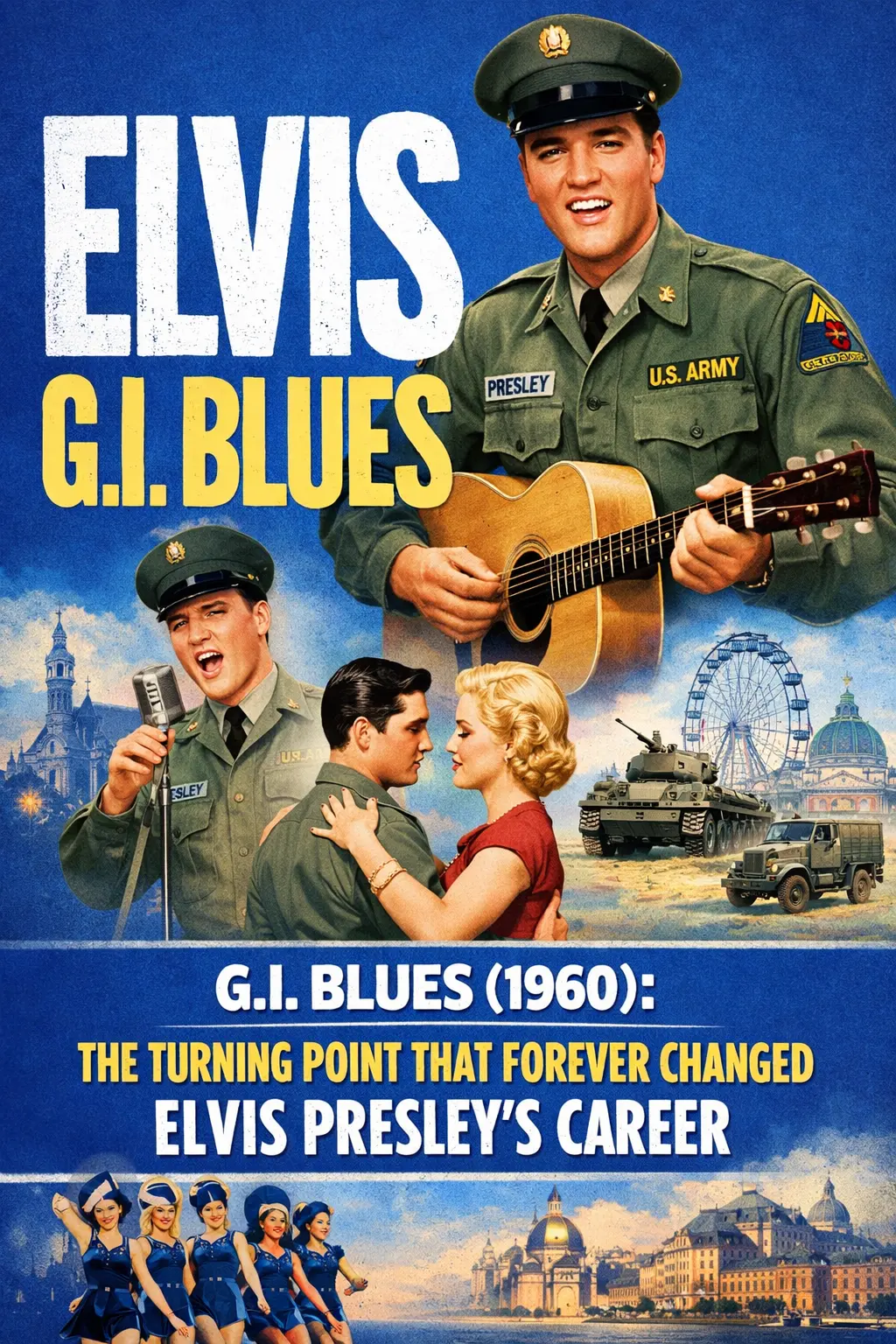
The Plot: A Wholesome Turn in West Germany
In his pre-Army films like Jailhouse Rock (1957) and King Creole (1958), Elvis played rebellious, brooding anti-heroes who challenged authority. G.I. Blues marked a sharp departure from this edgy persona.
Elvis plays Tulsa MacLean, a clean-cut, polite U.S. Army specialist and tank crewman stationed with the 3rd Armored Division in West Germany. Tulsa and his buddies are talented musicians who dream of opening their own nightclub back home after their discharge.
To raise the $300 they need for the lease, Tulsa enters into a high-stakes wager with a rival squad. The bet? Tulsa must spend the night with Lili (Juliet Prowse), a sophisticated and aloof cabaret dancer known for rejecting the advances of every soldier in the division.
When the soldier originally chosen for the wager is suddenly transferred, Tulsa is forced to step in. As he tries to win the bet, he predictably finds himself falling in love with Lili, leading to a series of comedic misunderstandings and musical numbers.
The story is light, breezy, and entirely non-threatening to the older generation who had previously feared Elvis’s corrupting influence on American youth. By putting Elvis in a military uniform and casting him as a patriotic, baby-sitting soldier, the film successfully repackaged him as family-friendly entertainment.
Production Trivia: Real Tanks and Hollywood Soundstages
While G.I. Blues is set against the scenic backdrop of the Rhine River and Frankfurt, West Germany, the reality of the production was much more Hollywood-centric.
Because Elvis was still active in the military during the early stages of planning, director Norman Taurog traveled to West Germany in August 1959 to shoot background plates, exterior scenery, and action shots involving actual military tanks.
Once Elvis was discharged in March 1960, the primary cast assembled at the Paramount Pictures studio in Hollywood, where they filmed the dialogue and musical scenes on elaborately constructed indoor sets designed to mimic German towns, train cars, and nightclubs.
The U.S. Army cooperated heavily with the production, viewing the film as an excellent public relations tool. They provided military equipment, vehicles, and even real soldiers as extras, helping to showcase the life of an American G.I. in a highly positive, romanticized light.

The Soundtrack Phenomenon: Going Multi-Platinum
If the film’s plot was formulaic, the soundtrack was a commercial masterpiece. Released in September 1960, the G.I. Blues album spent a staggering ten weeks at the number one spot on the Billboard Top Pop Albums chart, remaining on the charts for a total of 111 weeks.
The record featured some of the most memorable tracks of Elvis’s cinematic career. The title song “G.I. Blues” set the military tone, while “Pocketful of Rainbows” and “Frankfort Special” showcased his smooth ballad style.
The breakout hit of the film, however, was “Wooden Heart.” Based on a traditional German folk song, the track featured Elvis singing portions of the lyrics in German. While RCA initially hesitated to release it as a single in the United States, it became a massive international hit, topping the charts in the United Kingdom and across Europe.
The album’s success proved that Elvis’s movies were no longer just films—they were highly effective, two-hour promotional videos for his record releases.
The Legacy: The Golden Cage of the Musical Comedy
G.I. Blues was a critical success in the sense that it did exactly what it set out to do: it welcomed Elvis back to the cultural mainstream and made a fortune. Screenwriters Edmund Beloin and Henry Garson were even nominated for a Writers Guild of America award, and the film finished as one of the highest-grossing movies of 1960.
Yet, this success had a dark side. The film’s producer, Hal Wallis, realized that the combination of a uniform, a light romance, beautiful scenery, and a hit soundtrack was a foolproof financial formula.
Wallis quickly applied this template to Elvis’s next major project, Blue Hawaii (1961), which was an even bigger success. From that point forward, Elvis was rarely allowed to deviate from the formula. When he attempted serious dramatic acting in movies like the Western Flaming Star (1960) or the drama Wild in the Country (1961), fans stayed away, and the box office suffered.
As a result, Elvis was locked into a cycle of increasingly cheap and repetitive musical comedies throughout the 1960s, a phase of his career that he privately despised but felt powerless to escape under Colonel Tom Parker’s management.
Final Thoughts: A Pleasant Icon of the Era
Viewed today, G.I. Blues remains one of the most enjoyable films in the Elvis catalog. It captures the King at a unique moment of transition: youthful and energetic, yet poised and professional.
Juliet Prowse’s dazzling dance numbers provide a perfect foil to Elvis’s charisma, and the soundtrack remains one of the finest collections of movie songs ever assembled. It may have marked the beginning of a creative trap, but as a standalone piece of 1960s entertainment, G.I. Blues is a delightful testament to the enduring power of rock and roll’s greatest icon.
Do you prefer Elvis’s rebellious pre-Army films, or do you enjoy the clean-cut musical era that began with G.I. Blues? Let us know in the comments below!