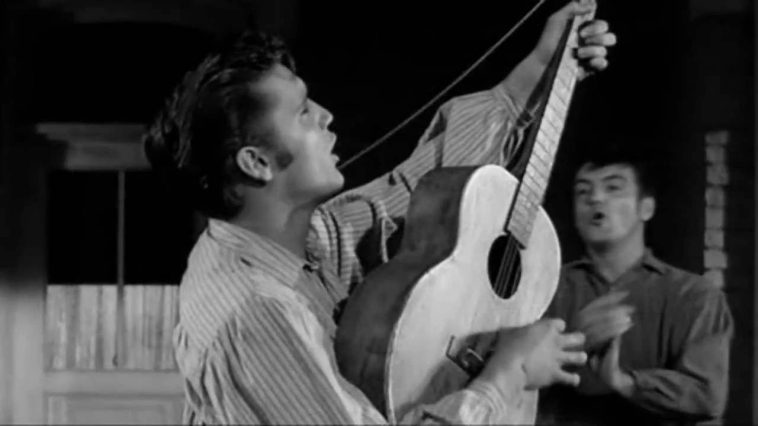
In the autumn of 1956, Elvis Presley was already the undisputed king of rock and roll. He had conquered the radio waves, caused national controversies on television screen with his swinging hips, and mobilized an army of teenage fans. But for Elvis and his ambitious manager, Colonel Tom Parker, music was only the first step. The ultimate goal was Hollywood.
Elvis’s silver-screen debut came with the post-Civil War Western Love Me Tender (1956). Over the course of the next decade and a half, Presley would go on to star in 31 feature films. However, decades later, film historians and music fans still debate the quality of his initial cinematic outing.
Was Love Me Tender a poor start for Elvis Presley’s acting career? To answer that, we must look beyond the film’s artistic merit and examine the financial triumphs, the critical backlash, and the complex precedent it set for his entire Hollywood tenure.
The Backstory: A Supporting Role Turned Promotional Machine
When Elvis first signed a contract with Paramount Pictures, he had dreams of becoming a serious dramatic actor. He idolized Marlon Brando and James Dean and wanted to tackle intense, emotionally complex roles.
His first opportunity came when he was loaned to 20th Century Fox for a Civil War-era drama originally titled The Reno Brothers. The film starred Richard Egan and Debra Paget, with Elvis cast in a supporting role as Clint Barlow, the younger brother who stays home and marries his brother’s sweetheart after the brother is falsely reported dead in the war.
However, once Colonel Tom Parker realized the marketing potential of the film, the project was radically altered. The title was changed to Love Me Tender to match Elvis’s latest single. Songs were hurriedly written and inserted into the film, despite the fact that a historical drama about the Reconstruction era had no logical place for rock and roll style ballads.
Crucially, Elvis was billed below the main stars. It was the first—and only—time in his entire career that he did not receive top billing.
The Commercial Verdict: An Unprecedented Triumph
From a financial standpoint, calling Love Me Tender a “poor start” is historically inaccurate. The movie was a box-office sensation.
Produced on a modest budget of around $1.2 million, the film recouped its entire production costs within just three days of its wide release. It eventually grossed over $4.5 million in the United States alone.
Teenagers lined up around the block to catch a glimpse of their idol on the giant screen. The film was so popular that print distribution couldn’t keep up with demand, leading 20th Century Fox to release it in an unprecedented number of theaters simultaneously—a release strategy that became a template for modern blockbusters.
Furthermore, the title track “Love Me Tender” sold over a million copies before the movie even premiered, marking the first time in music history a single had achieved gold status prior to release. Financially, the film proved to Hollywood that Elvis was a goldmine.
The Critical Verdict: Melodrama and Inexperience
While the accountants at 20th Century Fox were celebrating, film critics were far less enthusiastic. The reception from the press ranged from mild amusement to outright hostility.

Critics pointed out that Elvis’s acting was raw and unpolished. Lacking formal dramatic training, he frequently resorted to theatrical hand gestures and melodramatic facial expressions, particularly in the film’s emotional climax. The New York Times famously described his performance as “scarcely professional,” noting that his presence in the film felt more like a promotional stunt than a genuine performance.
The ending of the film also caused massive controversy among his fanbase. In the original cut, Elvis’s character, Clint, is shot and dies. During early test screenings, teenage girls in the audience wept so uncontrollably that producers feared a riot.
To appease the fans, the studio brought Elvis back to record a new ending. While Clint still died, a ghostly, transparent projection of Elvis was superimposed over the final scene, singing the title track as the credits rolled. It was a bizarre creative compromise that highlighted just how much the film’s artistic integrity was compromised for fan service.
The Dangerous Precedent: Music First, Art Second
The real tragedy of Love Me Tender is not that it was a bad film—it is actually a decent B-grade Western—but rather the precedent it established for Elvis’s career.
The massive financial success of the movie taught Colonel Tom Parker and Hollywood executives a dangerous lesson: a movie did not need to be good to make money, as long as it featured Elvis Presley singing a handful of songs.
Instead of allowing Elvis to pursue challenging dramatic scripts (he was later forced to turn down roles in West Side Story and A Star Is Born), his management locked him into a rigid formula. For the next decade, Elvis was pushed into a succession of lightweight, low-budget musical comedies. The formula was simple: Elvis plays a singing tour guide, helicopter pilot, or racecar driver, gets the girl, and sings ten mediocre songs.
By the mid-1960s, Elvis grew deeply depressed by the quality of his films, realizing that his dreams of becoming a respected dramatic actor had been permanently derailed by the commercial machinery that began with Love Me Tender.
Conclusion: A Double-Edged Sword
So, was Love Me Tender a poor start?
If we evaluate it as a launchpad for a highly profitable entertainment franchise, it was a massive success. It proved that Elvis’s appeal could translate to the silver screen, paved the way for his 30 subsequent films, and changed how Hollywood marketed movies to teenagers.
However, if we evaluate it as the beginning of an artistic journey, Love Me Tender was a misstep. By prioritizing music sales and fan service over dramatic storytelling, the film created the commercial blueprint that would ultimately trap Elvis in a Hollywood golden cage, preventing him from ever realizing his true potential as a serious actor.
How do you view Elvis’s acting debut? Do you think he had the potential to be a great dramatic actor, or was he always suited for musicals? Let us know in the comments below!