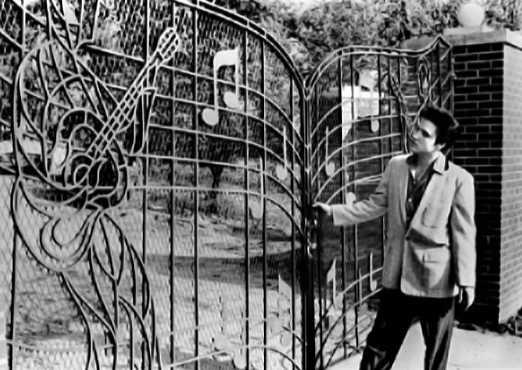
The Life, Career and Music of Elvis Aaron Presley
He inspired millions of people all over the world. He entertained his fans with records, concerts and films. He revolutionized show business and won its highest awards. He sold more recordings than any other artist and still holds numerous records to this day. Elvis Presley is a role model, myth, legend and cult. This is his story…
1935 to 1952
Elvis Aaron Presley was born on January 8, 1935, the son of laborer Vernon Elvis Presley (born April 10, 1916) and seamstress Gladys Love Presley (born Smith, April 25, 1912) in a two-bedroom wooden house in the small town of Tupelo/ Mississippi born. He is one of two twins; his brother Jesse Garon is stillborn and buried the next day in an unnamed grave in Priceville Cemetery. Elvis grew up in extremely poor conditions, but at the same time he was lovingly cared for and conscientiously brought up by his mother, who was unable to have any more children after the difficult birth.

In 1941, Elvis entered the East Tupelo Consolidated School. On October 3, 1945, he caused a musical stir for the first time when he performed the ballad “Old Shep” at the “Mississippi-Alabama Fair And Dairy Show” in his native town of Tupelo as part of a children’s talent competition and took 5th place. A little later, Elvis received his first guitar from his mother for his 11th birthday on January 8, 1946, bought in the Tupelo Hardware Store. It is the very natural musical influences of his surroundings that have an effect on the young Elvis: He absorbs the country music of the white lower and middle classes as well as the blues of the impoverished, oppressed black rural population. And he gets the gospels and spirituals, which he listens to in church with his strictly religious parents and soon sings himself, poured down like mother’s milk. In November 1948, the small Presley family moved to the city of Memphis, Tennessee, a two-hour drive away, hoping for better times. Elvis attended L.C. Humes High School there.
1953

The Presleys are doing a little better in Memphis than in Tupelo, but they’re not doing all that well either. After graduating from high school on June 3, 1953, Elvis gets a job at M. B. Parker Machinists’ Shop. He later works as a delivery driver for the Crown Electric Company. He occasionally sings at parties and school festivals until he discovers Sam Phillips’ Memphis Recording Service recording studio. Anyone can record their own record there for $3 and take it home with them. Elvis took advantage of the offer and recorded the ballads “My Happiness” and “That’s When Your Heartaches Begin” on a Saturday in June 1953 – not to give the record to his mother for her birthday (as the legend keeps saying), but to hear yourself on record and to draw attention to yourself. He says to the secretary Marion Keisker: “I sound like nobody else.” Keisker likes the soulful, unpolished singing style and the simple but effective guitar playing of the boy with the sideburns, whose phone number she writes down – a respectable success, but initially nothing happens to it . The disc with the private recordings, however, initially remained in the Presley household, was later lost and only miraculously reappeared in 1990.
1954
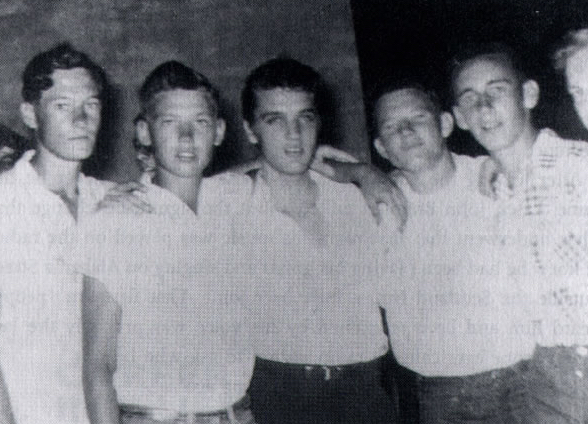
After Sun Records, Sam Phillips’ record company affiliated with the Memphis Recording Service, did not get in touch, Elvis reappears in the studio on January 4, 1954 to sing another record at his own expense. This time he records “I’ll Never Stand In Your Way” and “It Wouldn’t Be The Same Without You”. This time Sam Phillips is present himself and promises to get in touch. But that will have to wait until June. Then Phillips brought the now 19-year-old Elvis into the studio to have him sing the song “Without You”. The result doesn’t wow the Sun Records boss, but he introduces Elvis to promising young guitarist Scotty Moore, who rehearses a number of songs with him, assisted by bassist Bill Black. And on the evening of July 5, 1954, the time had come: the first real session took place in the Sun Studio with the three talents. The first tracks are ballads again, which don’t really want to fascinate… until Elvis suddenly starts with “That’s All Right”, a fast blues by the black Arthur Crudup from 1946. Scotty and Bill join in, and Sam Phillips seems struck by lightning: the recording mixes the rich old blues feel of the original with elements of country music. A new sound is born, a new style is found. And Sam Phillips has what he has been looking for for a long time: a white singer with the feeling and voice of a black man.
In the weeks and months that followed, Elvis Presley’s career took off. On July 19, 1954, Sun Records released “That’s All Right” with “Blue Moon Of Kentucky” on the B-side as the first official Elvis Presley record. Progressive disc jockey Dewey Phillips was the first to play the disc on his show “Red, Hot And Blue,” and other DJs followed suit, making “That’s All Right” a real minor hit in and around Tennessee. The newcomer’s first professional performances with Scotty Moore and Bill Black follow in July, including at Overton Park Shell, an open-air stage in Memphis, where Elvis moves wildly and impetuously to his fast tracks for the first time and thus finds his early performance style.
Scotty Moore manages the young Elvis as best he can in this initial phase and books more and more gigs, which soon lead to Texas, Louisiana and Arkansas. In September 1954, “Good Rockin’ Tonight,” a stunning rockabilly number for the time, was released as the second single on Sun Records. And on October 16th, Elvis premieres on the popular “Louisiana Hayride Show,” a radio show broadcast live every Saturday from Shreveport, Louisiana. Beginning in November, Elvis gets to appear on the show every weekend with Scotty and Bill, which is great promotion for the up-and-coming singer.
1955
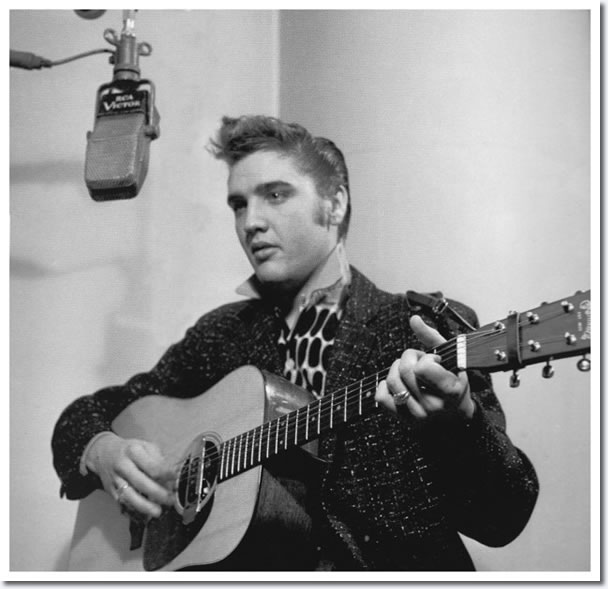
On January 1st, disc jockey Bob Neal takes over the management of Elvis, to the delight of an already overworked Scotty Moore. Elvis is on tour with his small band, which is soon joined by drummer DJ Fontana, almost all year round. The troupe plays primarily throughout the Southern States, and Elvis continues to attract larger and larger audiences. Sun Records releases more singles, of which “Baby Let’s Play House” and “Mystery Train” in particular sell well and are often played on the radio. Elvis is on the rise and is fighting for his audience land by land. Of course, this does not go unnoticed by the big names in business, and so from May 1955 a certain Thomas Andrew Parker, who bears the honorary title of ‘Colonel’, began to influence Elvis’ young career. Tom Parker, a Dutch immigrant (born Andreas van Kuijk on June 26, 1909 in Breda), has excellent contacts and a good reputation as the manager of country music stars Eddy Arnold and Hank Snow. From early summer, Parker books more and more appearances for Elvis and finally takes over his management alone from November 1955. Knowing that you can only really do anything as a singer with a major record label behind you, Parker engineered Elvis’ departure from the Sun, and that same month placed him with industry leaders RCA-Victor in New York.
1956

The first big Elvis year! On January 10th and 11th, 1956, the first session for RCA takes place in Nashville, which continues later in the month and produces such classics as “Heartbreak Hotel”, “Blue Suede Shoes” and “I Got A Woman”. Elvis retains his Sun musicians but adds experienced session staff in pianist Floyd Cramer and backing choir The Jordanaires. The Jordanaires in particular had a lasting impact on Elvis’ sound over the next 12 years. “Heartbreak Hotel” will be released in January as the first Elvis single on RCA; surprisingly it’s not really a rock ‘n’ roll song, more of a blues. And on January 28, 1956, the breakthrough came: Elvis made his first television appearance on the “Dorsey Brothers Stage Show”. Five more that Tom Parker has agreed with the Dorseys will follow by the end of March. Elvis Presley became known to the entire nation and, after a slow start, “Heartbreak Hotel” became his first number 1 hit, selling millions.
Things are now picking up speed. The first LP “Elvis Presley” was released in March and also sold millions, followed by the second single “I Want You, I Need You, I Love You”, which just missed number 1 in the hit parade. Elvis has made other television appearances on The Milton Berle Show (April 3rd and June 5th) and The Steve Allen Show (July 1st). These are so spectacular that they promote him and his records enormously. Between sessions and television appearances, Elvis tours almost non-stop throughout the United States. Scenes of hysterical enthusiasm play out among the teenage audience, but at the same time the stuffy establishment of parents, church officials and politicians begins to take to the barricades, prudish and indignant. Elvis’ performance and singing style is obscene and will spoil youth…
But the ‘fiend’ who never wanted to be a rebel is unstoppable, as is the fanaticism of the fans. The single “Hound Dog”/”Don’t Be Cruel” becomes a mega hit in the summer and sells seven million copies. Gradually, attention is also being paid to Elvis in Europe, and besides, Hollywood is already calling. In September 1956, 20th Century Fox produced Elvis’ first feature film, directed by Robert Webb, a western without rock’n’roll but with the simple ballad “Love Me Tender” as the title song, which became the next huge hit. And finally, Elvis opponent Ed Sullivan can no longer avoid booking the singer, who has just become the King of Rock’n’Roll, for his popular television show. The two appearances on the “Ed Sullivan Show” on September 9th and October 28th, 1956 ensure record ratings and finally establish Elvis as the new absolute number 1 star in show business.
One of Elvis’ outstanding character traits is that, despite his enormous success, he never changed significantly in his behavior towards people. Elvis remains humble and friendly especially towards his fans and never forgets where he came from. The only thing that is new is his pronounced generosity, now that he can afford it. This generosity is reflected in countless gifts to friends and acquaintances as well as in charity concerts, such as on September 26, 1956, when Elvis returned to his native town of Tupelo and paid the fee for his two triumphant open-air concerts as part of the “Mississippi-Alabama Fair And Dairy Show” donates to the city.
1957
It goes on without a break. On January 6, 1957, Elvis makes his third and final appearance on The Ed Sullivan Show…and is only filmed from the waist up because CBS fears Elvis’ ‘obscene’ movements will provoke a storm of protests from his regular adult viewers . Compared to 1955 and 1956, Manager Parker cuts the tour program down significantly in 1957, but Elvis still triggers increasing mass hysteria with the concerts that are still taking place. This also applies to Canada, where Elvis made his first appearance in April 1957, first in Ottawa and Toronto, where two concerts each took place. Later in the year, Elvis comes to Vancouver, where on August 31, 1957 he transforms the Empire Stadium, which was filled with almost 30,000 spectators (!), into a witch’s cauldron.
Compared to live shows, film work is already gaining in importance this year. In 1957 two more movies with Elvis were made, “Loving You” at Paramount and “Jailhouse Rock” at Metro-Goldwyn-Mayer (MGM). In contrast to “Love Me Tender”, Elvis can play himself in both films: a young, up-and-coming rock ‘n’ roll star who sometimes goes his own way in a rough way but always honestly. In both strips Elvis shows committed and motivated that he has acting talent. The films go around the world and drive Elvis fever to all continents. The soundtrack albums are pure rock ‘n’ roll and sell sensationally, as do the singles of the year: With “Too Much”, “All Shook Up”, “Teddy Bear”, “Jailhouse Rock” and “Don’t” Elvis landed five number 1 hits in a row.
But Elvis is more than just the king of rock’n’roll, who brings forbidden dreams to teenage girls with the occasional ballad. In 1957, the new pop music champion already showed his enormous musical range by indulging his passion for gospel with the EP “Peace In The Valley” for the first time and releasing his first Christmas record with the LP “Elvis’ Christmas Album”. Elvis spends the festival for the first time in Graceland, his dream villa, which he bought as a new home in March.
1958
At the first peak of his popularity, the King faces doom: the US Army has eyed Elvis and intends to draft him into service. Elvis gets a delay and just manages to finish his fourth feature film at Paramount: “King Creole” will be a masterpiece and is considered the best Elvis film ever. Elvis shows an excellent performance under the direction of the top director Michael Curtiz, who staged “Casablanca” with Humphrey Bogart in 1943. Elvis has another real star in Walter Matthau, and the stunning soundtrack does the rest, boldly blending elements of rock ‘n’ roll, blues and Dixieland against a New Orleans backdrop. “King Creole” hits the cinemas in June 1958 and delights not only the fans but also the critics.
For Elvis himself, the whole magic is already over. On March 24th he enlisted in the army and completed his basic training in Fort Hood/Texas. In June he records some new songs during a short vacation in Nashville. Producer Steve Sholes has added a few other top musicians to Elvis’ regular band; Hank Garland shines on guitar, Buddy Harman drums as second drummer, and Bob Moore replaces Bill Black on bass. The result is qualitatively great, but quantitatively unsatisfactory, since only 5 songs are created.
Then Elvis suffers what is probably the worst stroke of fate in his life. On August 14, 1958, his beloved mother Gladys died of heart failure; the 46-year-old has barely coped with the crazy hype surrounding her boy over the past three years. Now the Army; Gladys is worried sick, obviously alcohol and medication are added, that’s too much. Elvis weeps bitter tears, but there is not much time to mourn…
In September 1958, Elvis’ American fans, who were already horrified by the career break caused by the army, were completely shocked: Elvis was transferred to the 3rd US Armored Division in Germany. On September 22 in New York, after a final series of filmed press conferences and interviews marketed under the term “Elvis Sails,” Elvis boards the troop transport “General Randall” and travels to Germany with hundreds of other US soldiers. On October 1, he arrives at Kolumbuskaje in Bremerhaven, is greeted enthusiastically by the German fans and continues by train to his unit in Friedberg in Hesse. Elvis does not live in the barracks, the Ray Barracks, but in neighboring Bad Nauheim, where he initially sleeps in the hotel – most of the time in Grunewald – before he rents a house in Bad Nauheim’s Goethestraße 14 for himself and his companion in the spring of 1959 , which consists of father Vernon, grandmother Minnie Mae, and bodyguards Red West and Lamar Fike. As a soldier, despite his star status, he claims almost no special rights and does very well as a normal ‘GI’.
1959
Elvis spends the entire year as a US soldier in Germany. Meanwhile, his career is practically on hold and RCA and ‘Colonel’ Parker are struggling to keep him in business as there aren’t that many unreleased songs in the archives. Spread out over the year, only the singles “A Fool Such As I” and “A Big Hunk O’ Love”, both of which become top hits, as well as a few hit compilations on EP and LP. Elvis himself is plagued by homesickness and worries about his career, but uses his stay in Germany to establish close contact with the European fans who are always besieging him and to make two trips to Paris in France.
The most significant event of the year is almost the meeting with the 14-year-old Air Force officer’s daughter, Priscilla Beaulieu, on Sunday, September 13, 1959. Elvis apparently immediately took a liking to the pretty, very natural-looking schoolgirl, and so things are moving between the two slowly and cautiously a relationship.
1960

On March 2, Sergeant Elvis Presley returned to the USA from the Frankfurt/Main air force base in a four-engine transport aircraft. A one-hour layover at Prestwick Military Airport in Scotland is Elvis’ first and only stop in Britain. On March 5, 1960, Elvis is officially discharged from the US Army and returns from Fort Dix/New Jersey by train to Memphis and Graceland, where he announces his future plans in a press conference on March 7, 1960, but not his relationship with Priscilla conceals but downplays.
Shortly thereafter, Elvis and Tom Parker set about starting the comeback. The most important thing is the recording of new songs, and so in March/April 1960 a total of 18 brand new titles emerge, including the songs “Stuck On You” (a rock ‘n’ roll number in the style of “All Shook Up”), “It’s Now Or Never’ (an English-language adaptation of the Italian classic ‘O Sole Mio’) and ‘Are You Lonesome Tonight?’ (a heartbreaking ballad), which were released back-to-back as singles and, selling millions of copies, took Elvis back to number one on the charts . “It’s Now Or Never” even surpassed “Hound Dog” with a total of 21 million units sold and became the most successful Elvis single ever. The song also features Elvis as a vocally enhanced troubadour a la Mario Lanza. In contrast, the LP “Elvis Is Back!”, released in April 1960, is peppered with such rough blues that one notices that Elvis has not only not lost his versatility but has even expanded it.
On May 12, 1960, Elvis can be seen live on stage again for the first time. On this day, ABC broadcasts the television show “Welcome Home, Elvis” (actually the “Frank Sinatra Timex TV Show”), which was already taped on March 26 in Miami. Elvis presents the two songs from the “Stuck On You” single and looks like a wolf next to an aging sheep in a duet with host Frank Sinatra.
The comeback is crowned by two films that hit the cinemas in 1960: In “G.I. Blues” Elvis plays a US soldier stationed in Germany (how surprising!). Tom Parker’s clever move to waste his protégé’s military service in a highly publicized Hollywood film leads to a new huge success. The film grossed millions, and the soundtrack LP (including a version of the German folk song “Muss i denn…”) became one of the most successful Elvis albums. On the other hand, the western “Flaming Star” doesn’t do so well because Elvis only sings 2 songs in it. The dramatic role of the half-blood Pacer Burton, directed by Western specialist Don Siegel, shows once again what Elvis is capable of as an actor if you let him…
1961
On February 25th Elvis will perform 2 benefit concerts at the Ellis Auditorium in Memphis and on March 25th a benefit concert at the Bloch Arena in Pearl Harbor/Hawaii in aid of the “U.S.S. Arizona Memorial”. These are the last live performances until 1968/69. Manager Parker wants to put an end to the show tinkering and continue to establish his protégé’s image change from (supposed) rock rebels to ‘All American Boy’, which was carried out by the army service. Elvis becomes a clean star for the whole family and promptly lands the next number 1 hit with the hit “Surrender”, another originally Italian title.
After “Wild In The Country”, in which Elvis plays a serious role for the last time in many years, the film “Blue Hawaii” is followed by a syrupy kitsch comedy – albeit a skillful one! An almost non-stop singing Elvis in front of the dream backdrop of Hawaii, a couple of pretty and of course very decent bikini girls and a brilliant soundtrack in which Elvis mixes rock and pop with Hawaiian sounds in a bold way again, result in a mixture that tops almost everything . Produced by Hal Wallis and directed by Norman Taurog, it became the highest-grossing Elvis film ever, the soundtrack LP one of his best-selling albums, and the single “Can’t Help Falling In Love” another world hit.
1962
The Elvis machine, the way Tom Parker likes it best, runs like clockwork. Three more uncomplicated but well-made entertainment films are coming to the cinemas and making the box office ring: “Follow That Dream” is followed by the boxer film “Kid Galahad”, in which even the punches of the fight opponents cannot prevent 6 lively songs before “Girls! Girls! Girls!” almost a copy of “Blue Hawaii” hits theaters. The soundtrack albums on EP and LP sell like sliced bread, and the singles burn, regardless of whether they come from the movies or not. “Good Luck Charm” reaches number 1 (albeit as the last Elvis single in the USA until 1969), and “She’s Not You” and “Return To Sender” are also super hits, even if they miss the top position, at least in America.
On June 17, 1962, Elvis and Priscilla meet again for the first time. More than two years after the spatial separation, the now 17-year-old visits her hero in Graceland, and both understand each other as if the farewell in Frankfurt/Main was only two weeks ago…
1963
Two other films are coming to theaters: It Happened At The World’s Fair, in which Elvis plays a singing freelance pilot, and Fun In Acapulco. In the latter, as in “King Creole” and “Blue Hawaii”, Elvis skilfully combines music styles that actually seem incompatible, this time rock and pop with Latin American sounds. The reward is another huge success in the cinema and in the record charts, where the single “Bossa Nova Baby” easily makes the top ten.
1964
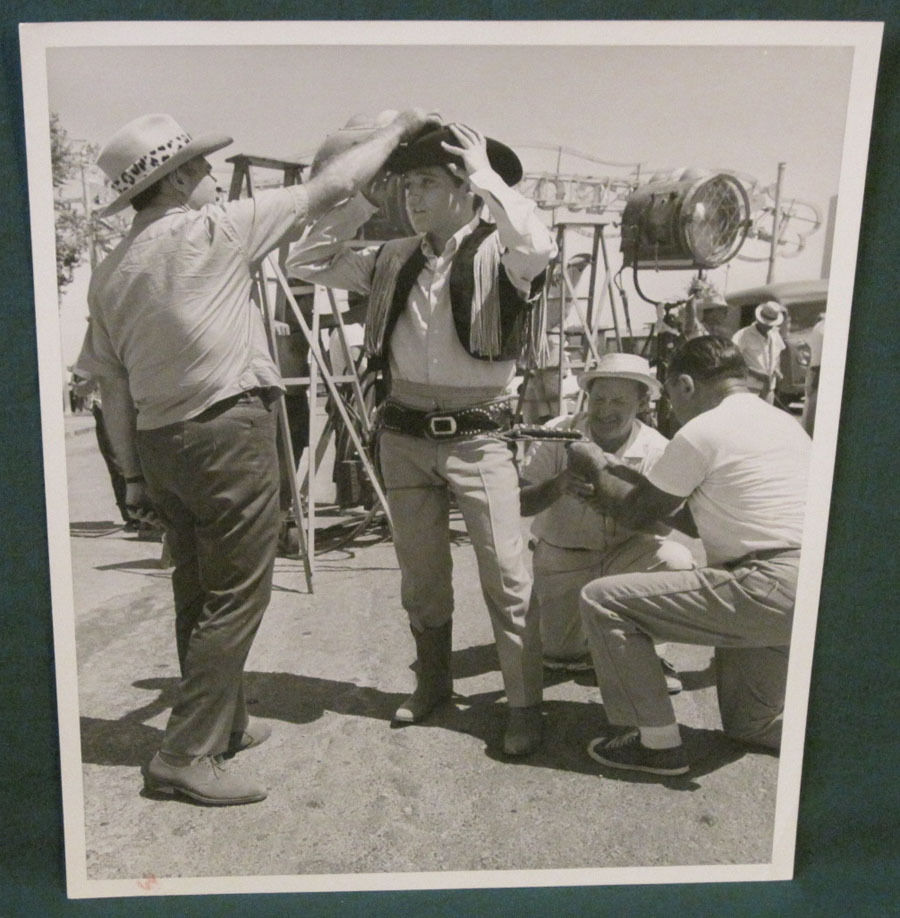
New year, old scam, new successes: the Elvis machinery throws three new films onto the market. “Kissin’ Cousins” is particularly unusual because Elvis plays a double role in it. “Viva Las Vegas” is pure dynamite, as Ann Margret is brilliant as a female co-star, the soundtrack is completely convincing and the car racing scenes embedded in the plot are spectacular. The flick achieves success that rivals that of “Blue Hawaii,” and RCA can even afford to oversleep the release of an LP soundtrack. That doesn’t happen with “Roustabout”; Although the story of the reluctant fairground hero is not as bright as that of the singing racer in the previous film, the LP lands cleanly at number 1 on the US album charts.
1965
Elvis is now 30 years old and fans are starting to wonder if it should just continue with entertainment films and soundtrack albums. The Beatles are now conquering the world, the Rolling Stones are here, and Bob Dylan opens up new levels with the combination of rock, folk and political messages. Elvis and Tom Parker, however, stick to their winning streak, and that’s still going well. Again there are 3 films coming out, all making big profits: ‘Girl Happy’, ‘Tickle Me’ and ‘Harum Scarum’ (called ‘Harem Holiday’ in the UK), the latter being yet another musical experiment, mixing rock and pop this time linked to Arabic motifs. Still, Elvis’ career is beginning to take a downturn, and the one-time superhero has since lost his role as a trendsetter.
1966
A year almost like the previous one: As usual, Elvis and his manager bring three new films to the cinemas and throws three soundtrack LPs after RCA. “Frankie And Johnny” is the most convincing. The story with Elvis as the star of a Mississippi showboat troupe is staged briskly and reveals a few highlights in the soundtrack such as the title song and the blues “Hard Luck”. In contrast, “Paradise, Hawaiian Style” and “Spinout” (called “California Holiday” in Great Britain) fall behind. While Elvis was able to land a real hit last year with the gospel-pop song “Crying In The Chapel” (3rd place in the USA), this time he didn’t manage a single Top Twenty hit with the exception of “Love Letters”. , and the movie albums don’t reach high rankings anymore either. 1966 is certainly not a complete crash, but it is becoming clear that it is time for something new, for something contemporary.
1967
The event of the year is a non-musical one: On May 1, 1967, Elvis Presley (32) married his longtime girlfriend Priscilla Beaulieu (21) in Las Vegas. Manager Parker is said to have pushed for an end to unmarried cohabitation and marriage for image reasons. The ceremony at the Aladdin Hotel is still a dream wedding. Elvis’ best man is his private secretary and later road manager Joe Esposito, and Priscilla’s bridesmaid is her younger half-sister Michelle. The couple is honeymooning in Palm Springs, California.
Meanwhile, the career of the former King is in a downturn that can no longer be denied. There are still no new live performances in sight. The newly released films “Easy Come, Easy Go”, “Double Trouble” and “Clambake” are seeing an alarming decline in cinema audiences, and the soundtrack LPs and single releases are crashing down the charts. The only real bright spot of the year is the album “How Great Thou Art”, released in March 1967, Elvis’ second gospel LP after “His Hand In Mine” from 1960. The record with songs that Elvis had already recorded with the Jordanaires and first recorded the Imperials under the direction of its new producer, Felton Jarvis, is a masterpiece. It shows that the champion still has what it takes and earns him his first Grammy.
1968
At the beginning of the year there were non-musical headlines again: On February 1, 1968, Elvis and Priscilla’s healthy daughter Lisa Marie was born at the Baptist Memorial Hospital in Memphis.
There are three new films in cinemas: “Stay Away, Joe” is followed by “Speedway”, which lacks the highly authentic racing scenes from the popular NASCAR series and the participation of Nancy Sinatra as a female co-star to the success of previous proportions can help. “Live A Little, Love A Little” feels modern and even freaky compared to previous Presley films, but it doesn’t really pack a punch either. And so it is good and urgently necessary that the turning point is approaching. Alarmed by the drop in revenue, ‘Colonel’ Parker and NBC engineered a TV show for Elvis, which was taped with producer and director Steve Binder in Burbank, California in June 1968. Binder wants to show Elvis again as an unvarnished, unadulterated musician and thus prevails against Parker’s ideas of a family kitsch show because Elvis agrees with him, bored with the years of Parker’s Hollywood dreariness.
On December 3, 1968, “Elvis’ TV Special” was broadcast and hit like a bomb. Although the 60-minute show still shows some musical sequences reminiscent of Hollywood Elvis, the live sequences, which show Elvis as a tough, elemental rocker in black leather, are so powerful, so dynamic and so explosive that make the special one of the best projects of Elvis’ entire career. The huge success of the show, which ultimately went down in music history as the “’68 Comeback Special”, is accompanied by the single release “If I Can Dream” (a song with a serious message, as you would expect from an Elvis Presley never heard of) and an accompanying soundtrack LP. Both records bring Elvis back to good chart positions. The return of the king to the throne is initiated…
1969
After the resounding success of the TV special, two essential steps are still missing for a real comeback: recording new, independent, modern songs and returning to the concert stage. The former occurs in January and February 1969 at a multi-part session at Chips Moman’s American Sound Studios in Memphis. With the resident band led by pianist Bobby Wood and guitarist Reggie Young, who have their own cutting edge sound, Elvis records over 30 brand new songs, mostly soul, country and heavy ballads. “In The Ghetto,” “Suspicious Minds,” and “Don’t Cry Daddy” all hail from these sessions and become new smash hits for Elvis throughout 1969, with the socially critical lyrics of “In The Ghetto” infuriating Elvis himself -Critics were positively surprised and “Suspicious Minds” was the first Elvis single since 1962 to return to number 1 in the US singles charts. On LP, the Memphis sessions are reflected in the albums “From Elvis In Memphis” and “Back In Memphis”, which also sell brilliantly and receive very good reviews.
And finally, after 8 years, Elvis finally returns to the concert stage. Tom Parker negotiates a month-long residency deal with the brand new International Hotel in Las Vegas. Interest is huge, and when Elvis goes on stage on July 31, 1969 after weeks of preparation and rehearsals, all 57 concerts are sold out through August 28 (2 shows per night). Elvis presents himself in top form in front of the 2200 spectators, he is more dynamic than ever before and at the same time matured compared to the early years of his career. The song program is balanced between old hits, new successes and evergreens. To start over, Elvis assembled a whole new band, led by lead guitarist James Burton, along with John Wilkinson on rhythm guitar, Jerry Scheff on bass, Ronnie Tutt on drums and Larry Muhoberac on piano (who played against Glen Hardin is exchanged). The TCB Band has found itself, and the big top line-up is rounded off by the Sweet Inspirations as the female and the Imperials as the male backing choir and an orchestra with Bobby Morris (from August 1970 Joe Guercio) as conductor. Also present are the soprano Millie Kirkham (from mid-August 1970 Kathy Westmoreland) and Elvis’ friend Charlie Hodge as acoustic guitarist, harmonies singer and jack of all trades on stage.
The concerts received an overwhelming response. The fans love it, the critics love it. One speaks of the most impressive comeback in rock history. Elvis has reclaimed the throne, he is king again. The fact that three more feature films with Elvis were produced and released in 1969 due to corresponding contracts, of which at least the western “Charro!” and the drama “Change Of Habit” are of a higher standard, is almost only noticed by hardcore fans. From now on, Elvis will not make any more feature films. He has returned to his best element, performing live in front of his fans.
1970
After the triumphant comeback of 1968/69, both manager Parker and Elvis are clear that live concerts will now follow regularly again. And so, in January 1970, Elvis returned to Las Vegas to the International Hotel. Way too fast, some say, but Elvis proved the skeptics wrong and once again managed to sell out all 57 shows between January 26th and February 23rd. Wearing jumpsuits (one-piece, lavishly decorated suits) on stage, he practically reinvents himself: he’s no longer the rock ‘n’ roller or the Hollywood glamor man, let alone a traditional Las Vegas star in a tuxedo . What Elvis brings to the stage is completely new; it’s like a super pop show with him as a universal super entertainer who playfully switches back and forth between all musical styles, moves dynamically, kisses the ladies and can also tell a funny story.
The second Las Vegas guest performance was followed by six concerts in the huge Astrodome in Houston/Texas between February 27th and March 1st, 1970, where Elvis was integrated into the rodeo program of the “Houston Livestock” as a special attraction. After another mammoth session in June, this time again in Nashville, another 34 new songs of all styles were created, Elvis returns to Las Vegas in August. Between August 10 and September 8, 1970, Elvis gave 58 new, groundbreaking concerts there. As was the case during rehearsals in July, MGM will be present during the first days of the guest performance filming for a documentary that will be released in December entitled “Elvis – That’s The Way It Is”. The strip, directed by Denis Sanders, impressively shows all the magic of the concert Elvis of the early 70s and goes down in history as another milestone.
Directly after the renewed triumph in Las Vegas, Elvis goes on tour in the USA for the first time since 1957 and inspires tens of thousands of fans between Phoenix/Arizona and Mobile/Alabama at a total of 8 concerts. The same happens with a second tour in November along the west coast. So there are 138 concerts that Elvis gave in 1970 alone.
Elvis hits the record market again in 1970. He lands three more massive hits with “Kentucky Rain”, “The Wonder Of You” and “You Don’t Have To Say You Love Me”, and the albums “On Stage – February, 1970” (new songs that are directly in Las Vegas recorded live) and “Elvis – That’s The Way It Is” (the LP for the film of the same name) are also doing excellently.
1971
Elvis has re-established himself in show business. The King of Rock’n’Roll has become the King of Entertainment, and in 1971 he’s really rocking it again. Between January 26 and February 23, Elvis will perform 57 more times at the International Hotel in Las Vegas. The hotel is now part of the Hilton chain of hotels and will soon be called The Las Vegas Hilton. Between July 20th and August 2nd, 1971, Elvis made his first guest appearance at the Sahara Hotel on Lake Tahoe, also for 2 shows per evening, before returning with his troupe to the Las Vegas Hilton on August 9th for another 4 weeks. In November there will be a big USA tour, with J.D. Sumner & The Stamps performing the male backing choir instead of the Imperials for the first time. Overall, Elvis completed 156 concerts this year, all of which are sold out again.
The outstanding Elvis record of the year is the LP “Elvis Country”, a true concept album that once again delights fans, record buyers and critics alike. The singles, on the other hand, are bobbing at least in the USA after the high of 1969/70 again in the no man’s land of chart positions from 30 down. This is of course not so much due to weak sales, but to a lack of radio broadcasts (in America, the chart positions are calculated from both record sales and radio broadcasts). This lack of ‘air play’ is partly due to manager Parker’s unwillingness to issue larger numbers of singles to radio stations for promotional purposes. Who doesn’t need it…
1972
The year traditionally begins with a 4 week engagement at the Las Vegas Hilton from January 26th to February 23rd. After that, a new big USA tour will start in April, leading from Buffalo/New York via Detroit/Michigan and Dayton/Ohio to the old South and ending on April 19th after 19 concerts in 15 cities in Albuquerque/New Mexico . MGM is back and, in addition to the rehearsals in March, is filming a total of 5 shows of the tour plus a lot of the surrounding stuff for a new documentary that will be released at the end of the year under the title “Elvis On Tour”. The film, directed by Pierre Adidge and Robert Abel, is the logical follow-up to That’s The Way It Is; both films together represent the King’s live mainstays in the 70s, namely Las Vegas on the one hand and touring on the other. In “On Tour” Elvis doesn’t seem quite as dynamic as in “That’s The Way…”, but this small shortcoming is made up for by the fascination radiated by the gigantic dimensions of an Elvis tour through the largest arenas in America.
Already in June Elvis is on the road again. This time, the Presley show is touring the northern states, and the prelude is already a spectacle of the first order: from June 9th to 11th, after an entertaining TV press conference, Elvis will be giving 4 concerts over 3 days in New York’s famous Madison Square Garden, where the Champion captivates 20,000 fans per show. The second highlight of the concert trip is Chicago, the other super city in the north, where exactly one weekend later Elvis again attracts 20,000 fans each to 3 shows in Chicago Stadium; a total of 140,000 visitors see Elvis in top form in New York and Chicago alone.
The Elvis empire shines brighter than ever and is only overshadowed by the fact that the king only appears in North America. There are more than enough offers from abroad, but ‘Colonel’ Parker rejects every offer, no matter how lucrative it may appear. The reason for this is by no means that the manager is an alleged illegal immigrant to the USA who can no longer leave the United States without being exposed. Rather, Parker thinks strictly in terms of market economy and sees that in view of the immense organization and transport costs in halls that are by no means larger, a European or Asian tour can never achieve the same profit as a USA tour. However, in order to send the magic of the concert Elvis around the world (and still earn plenty of money at the same time), he plans to present Elvis live to fans overseas via television.
But before that happens, Elvis returns to Las Vegas in August 1972 for another 4-week concert series and in November embarks on a third USA tour of the year, which ends in Honolulu/Hawaii and thus already a location test for includes the upcoming live TV special scheduled for January 1973 in the Hawaiian capital.
In 1972 Elvis completed 165 sold-out concerts, more than ever before. His records are doing better again: With “Burning Love” Elvis releases a modern rock song and lands a world hit for the first time in two years. The live LP Elvis As Recorded At Madison Square Garden featuring the Saturday night show from New York on June 10 is also a huge hit, and the gospel album He Touched Me earns Elvis his second Grammy.
January 14, 1973
On January 9, 1973, one day after his 38th birthday, Elvis flew to Hawaii with his entourage. There he rehearses intensively for the greatest spectacle of his entire career. And so, on Sunday, January 14, 1973, the television concert “Elvis Aloha From Hawaii” was broadcast live from the International Center in Honolulu via the Intelsat IV satellite to the entire Asiatic and Oceanic region. Around 15 countries – including Japan, South Korea, South Vietnam, the Philippines, Thailand, Australia and New Zealand – are adopting the show broadcast by NBC directly. The ratings are astronomical and are between 70 and over 90 (!) Percent.
The Europeans, on the other hand, are literally in the wrong film: the live project is too expensive for the broadcasters, and they are limited to broadcasting recordings in the following weeks. This is also the case in the USA, but here with calculation. Because the first broadcast of “Aloha From Hawaii” on April 4, 1973 is enhanced by 4 bonus songs that Elvis recorded in the empty hall after the live concert and that are interspersed with wonderful landscape shots in the US version of the show . But whether live or canned: by mid-1973, the concert was seen by around a billion TV viewers (= a third of the world’s population at the time) in 36 countries around the world – an incredible record. The live double album with the (almost) complete show was released simultaneously worldwide on February 1, 1973 and became a mega success (including number 1 in the US album chart). The single “Steamroller Blues” also developed into another real hit for Elvis.
With the Aloha Show, Elvis Presley reached the pinnacle of his career, both commercially and artistically. In concert, the King appears more royal than ever in his “Aloha Eagle Suit” specially designed for the project. During his performance he largely refrains from his typical movements in order not to offend the foreign Asian cultures. But he presents himself vocally and musically more grandiose than ever. Most of his own hits are missing from the song program; instead there are a number of new titles to be heard and a potpourri of classics and evergreens of all styles, which Elvis interprets so powerfully and convincingly that one is completely mesmerized by so much skill. Once again, the King of Entertainment has lived up to his reputation and won a very big victory.
1973
After the triumph of the Aloha Show, Elvis could have taken a longer break. Instead, he does exactly the opposite and literally throws himself onto the stage. With the traditional two Las Vegas guest performances (January/February and August/September), a new engagement at the Sahara Hotel on Lake Tahoe (May) and two USA tours (April and June/July) he gives a total of 166 concerts and thus surpasses even beat its previous year’s record. Furthermore, all shows are sold out in advance, and at the tour concerts the King is still fully motivated and in the best of moods. In Las Vegas this is no longer always the case, because Elvis is getting more and more annoyed by the monotony of the same setting every evening and being locked up in the golden cage of his suite for weeks.
It is not even surprising that Elvis’ records in the course of 1973 after the super success of the high-quality Aloha releases dropped in quality and were rather behind in the charts. The LP Raised On Rock, featuring the title track as a single, is a good example of this, although these two releases aren’t nearly as bad as the critics make them out.
Of greater concern are the personal and health problems Elvis faces in 1973. After his wife Priscilla had an affair with her karate teacher Mike Stone and moved out of Graceland with their daughter Lisa Marie in February 1972, the Presley marriage ended on October 9, 1973 in Santa Monica/California. While Elvis has comforted himself with the beautiful and sensitive “Miss Tennessee” Linda Thompson (who many would have thought was a much better Mrs. Presley) since the summer of 1972, the champion is deeply hurt. It’s safe to assume that the deep hurt is caused less by the loss of his small family than by the fact that he, as the ultimate male sex symbol and archetype of the Southern gentleman, has had his wife practically publicly run off with another guy. But the effect on the soul is the same. And the body is also causing serious problems: an eye disease that first appeared in 1971 is steadily getting worse, along with constipation and blatant insomnia. In 1973, several concerts in Las Vegas and Lake Tahoe had to be canceled for health reasons, a novelty in the man from Memphis’ brilliantly white career to date.
1974
This year is widely viewed as the beginning of the final Presley decline; in truth Elvis gets the curve once again quite convincingly in 1974! He seems to have come to terms with his new personal circumstances and seems physically well recovered compared to the summer of last year. Manager Parker shortens the previous 4-week Las Vegas guest performances to 2 weeks for the first time in order to gain more time for the tours, which despite the higher advertising and transport costs are simply more lucrative than the Vegas engagements due to the significantly larger number of spectators in the Big city arenas. Elvis, in turn, sees this change as positive because of his growing antipathy to the Vegas situation. And so, after 29 shows over 15 days in January/February at the Las Vegas Hilton, from March 1, 1974 the King went on the longest US tour of his career up to that point. The tour will culminate in several concerts in Elvis’ hometown of Memphis, the last of which will be recorded for another live album on March 20th.
A short tour along the West Coast follows, culminating in 2 concerts at the Los Angeles Forum in front of 20,000 fans each and a guest performance at the Sahara Hotel on Lake Tahoe in May, before another extensive tour of North America in June/July causes storms of enthusiasm. On August 19th, Elvis returns to Las Vegas, where he will perform 27 times through September 2nd. Elvis has been looking good and healthy for months, he keeps fit with karate, he always presents new, colorful jumpsuits with almost childlike joy and – what is most important – he has many new and strong songs in his program like “Let Me Be There”. and “Why Me, Lord?” or the modern-sounding rocker “Promised Land”, which does remarkably well as a single in the charts and in record stores.
The fact that Elvis appears tired and ill on the next tour in September/October and the short engagement in the Sahara Hotel that immediately follows and seems to drag himself through the shows rather than offering charismatic entertainment does the excellent overall balance of the year with 156 sold-out shows concerts, 2 Top Twenty hits and 2 excellent albums (“Good Times” was released alongside the Memphis Live LP).
1975
Elvis Presley is now 40 years old and has been at the forefront of show business for almost 20 years. And it still has a lot to offer. After the traditional winter concerts in Las Vegas were postponed from January/February to March due to the opening of a new part of the building in the Hilton Hotel, Elvis is going on a big tour again from April. Until June, the champ will sweep through the southern states, his old homeland, like a tornado, only to bring the ‘Yankees’ in the north of the USA entertainment to the top level again in July. Elvis has a number of songs from his new LP “Elvis Today” in the program, including the single “T-R-O-U-B-L-E”, a rock number of the best kind. Elvis is enthusiastic about it and even buys a 4-engine long-haul Convair 880 jet plane, which he has rebuilt and redesigned according to his needs and wishes. He also makes sure that the plane he christens “Lisa Marie” can fly as far as Europe…
In the midst of the euphoria, however, comes the crash. In August 1975, Elvis traveled ill to the next guest performance in Las Vegas and had to break off the concert series after only 5 shows. A disaster. Elvis has not performed again for almost four months. But the king still has the strength to come back. In December 1975, Elvis made up for the unusual concerts in Las Vegas… and promptly set a new record by becoming the first artist to be able to sell out a guest performance in the show and gambling metropolis in the doldrums of December. And he goes one better: on December 31, the mega-star will give a spectacular New Year’s Eve concert in front of over 60,000 spectators in the huge Silver Dome in Pontiac/Michigan (near Detroit). It’s the largest setting Elvis has performed in front of in his entire career.
1976
The United States is celebrating its 200th anniversary, and Elvis is making a very personal contribution with the American Bicentennial Tour ’76, a multi-part mammoth tour across the United States, starting March 17 in Johnson City, Tennessee and ending on March 30 November in Anaheim/California ends. The tour includes a total of 99 concerts in 74 cities, which means that Elvis reaches more viewers than ever before in his career due to the size of the halls. In contrast, Las Vegas and Lake Tahoe are taking a backseat; ‘Colonel’ Parker only has one guest performance of 10 or 11 days in the Sahara and the Hilton.
The fans continue to pour into the arenas en masse; Elvis still effortlessly fills every hall, no matter how large. Apart from the new single “Hurt” and the anthem “America, The Beautiful”, which fits the patriotic occasion, Elvis doesn’t have much new to offer musically, but seeing and hearing the living legend is apparently enough. However, the gigantic dimensions of the tour and the roaring cheers of the crowds cannot really hide that something is no longer right. Elvis appears bloated and ponderous on many shows. He looks pale and unhealthy, and while his voice has lost none of its strength, he is sometimes short of breath and has difficulty speaking – the latter apparently caused by heavy medication.
Things are also going wrong behind the scenes: Father Vernon fires long-time bodyguards Red and Sonny West and karate specialist Dave Hebler on behalf of Elvis. The official reason is austerity measures, but in fact the often rude behavior of the bodyguards in public is the reason for the layoffs. Linda Thompson is sorted out and replaced by the very young Ginger Alden, who, with her stubbornness and the parasitism of her family, is not doing the aging mega-star any good in the long term. Dark clouds are gathering over the kingdom…
1977
Elvis belongs in a sanatorium and not on a concert stage. But nothing changes. From February 12, 1977, Elvis is on the road again, touring all over the United States. The shows are constantly up and down. Good performances, like in Charlotte/North Carolina, where Elvis sings his promising new single “Moody Blue” live for the first time, are followed by weak ones, like in Norman/Oklahoma. On May 1st and 2nd, Elvis attracted a total of 40,000 spectators to Chicago Stadium for two strong concerts, only to have to interrupt his show on May 29th in Baltimore/Maryland for almost half an hour due to complete exhaustion. The King looks frighteningly bad and bloated like never before. In addition to the diseases already mentioned, Elvis suffers from high blood pressure and water retention in his body, which his organism can no longer properly break down.
During the June tour, the television is there in all seriousness. ‘Colonel’ Parker has negotiated a new TV special with CBS. Elvis’ ongoing concert successes have not gone unnoticed by the broadcaster, but the main character’s current condition apparently has. CBS is filming the concerts in Omaha, Nebraska on June 19th and in Rapid City, South Dakota on June 21st… and is considering re-taping at a later date when Elvis may be feeling better. Meanwhile, Elvis ended the tour on June 26, 1977 in front of almost 17,000 fans in the sold-out Market Square Arena in Indianapolis/Indiana. It is Elvis Presley’s last public appearance. And almost as if he suspects that he is singing for his audience for the last time, Elvis gives the best concert of the past six months that evening…
For historical reasons, however, on October 3, 1977, a month and a half after Elvis’ death, CBS broadcast the TV special composed of the two filmed concerts under the title “Elvis In Concert”. The show ruthlessly shows Elvis’s distressed state, but at the same time illustrates three things that all of Elvis’ 1977 concerts have in common: First, Elvis’ unbroken ability to fulfill his task as an entertainer to the end, namely to ensure sold-out halls and enthusiastic fans. Second, Elvis’ still remarkable vocal quality and musical diversity. And thirdly, an almost infinite mutual loyalty – yes love! – between Elvis and his fans.
Aug. 16, 1977
In the last days of his life, Elvis Presley probably doesn’t know exactly where he stands. On the one hand, the 6-week break since the last tour has done him good. He is looking forward to the next concert tour, which is scheduled to start on August 17th in Portland/Maine and the shows are again all sold out. He wants to bring five new songs, and for the first time in months a new jumpsuit is ready for him. He plans to replace the moody Ginger Alden with a new partner and spends a lot of time with his daughter Lisa Marie, who is once again visiting Graceland. On the other hand, he is terrified of the wild scandalous book “Elvis – What Happened?”, which the bodyguards who were fired last year have meanwhile fabricated. How will the audience react? Will he have the strength to present himself better than at the previous months’ concerts?
On the morning of August 16, 1977, Elvis goes to bed. In the early afternoon, around 2 p.m., Ginger Alden is surprised that Elvis is not in bed next to her. She finds him lifeless on the bathroom floor shortly after. Road manager Joe Esposito rushes over, resuscitation attempts are started, an ambulance is called and takes Elvis at breakneck speed to the Baptist Memorial Hospital. While still in the car and then in the hospital, Elvis’ controversial personal physician, Dr. George Nichopoulos and then the hospital team did everything to bring Elvis back to life. But all efforts are in vain. At 3:30 p.m. on Tuesday, August 16, 1977, the terrible news spread around the world like wildfire: Elvis Aaron Presley died in Memphis/Tennessee at the age of 42.
August 1977 – After Elvis’ death
The news of Elvis Presley’s death hits like a bomb. Millions of people around the world are paralyzed and mourn uncontrollably. TV channels and radio stations immediately change their programs, and newspapers put the news in giant letters on the front page. In Memphis, more than 100,000 people gather in front of Graceland to mourn, learn something new and say goodbye to the King of Entertainment. Elvis Presley has become THE talk of the town these days in the summer of 1977.
At the request of Elvis’ father, Vernon, an autopsy will be performed at Baptist Memorial Hospital, led by Dr. Jerry Francisco performed to find out what the mega star died of. The investigation comes to the conclusion that Elvis suffered a heart attack. No evidence of illegal drug use such as heroin or cocaine was found, but residues of several powerful drugs were found in the deceased’s stomach.
On August 18, 1977, Elvis Presley was buried in a moving funeral service. In addition to father Vernon and other close relatives such as ex-wife Priscilla and daughter Lisa Marie, there are important friends such as Joe Esposito, Charlie Hodge, Jerry Schilling and George Klein, of course manager ‘Colonel’ Tom Parker, plus John Wayne and Caroline Kennedy, and Linda Thompson and Ginger Alden with their families. Kathy Westmoreland will sing along with gospel choirs The Statesmen, The Blackwood Brothers and J.D. Sumner & The Stamps. Pastor C.W. Bradley, televangelist Rex Humbard and Jackie Kahane, the comedian from Elvis’ concert opening act, give addresses. hearse is a white Cadillac; the motorcade that eventually makes its way to Forest Hill Cemetery includes 49 vehicles, followed spontaneously by a detachment from the biker group Hell’s Angels. The cemetery is covered with a sea of flowers and funeral wreaths from all over the world. US President Jimmy Carter issues a statement recognizing Elvis Presley as America’s pre-eminent symbol.
On October 2, 1977, the coffins of Elvis and his mother Gladys were moved from Forest Hill to Graceland after grave robbers attempted to steal Elvis’ body.