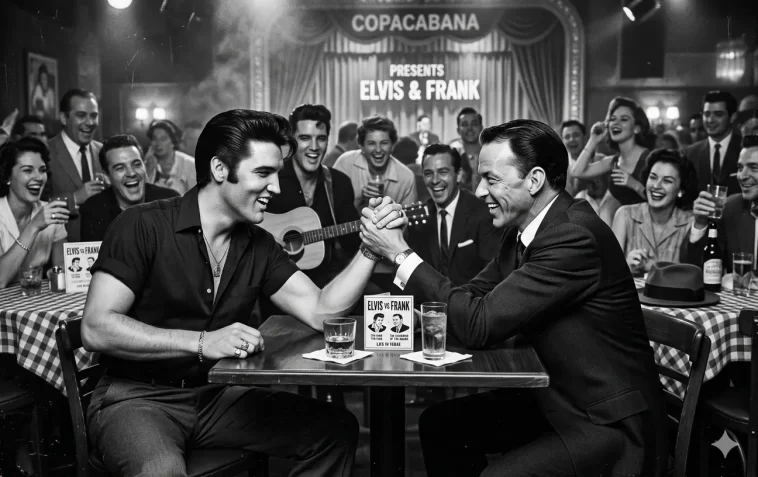
Elvis Presley vs Frank Sinatra — two names that define American music across two completely different generations. One ruled the airwaves with a velvet voice and a cigarette in hand. The other arrived with a swivel of his hips and turned the world of popular music inside out.
They came from different worlds. They represented different values. And yet both men became symbols of something far bigger than music alone — they became symbols of America itself.
So how do they stack up? Let’s take a serious look.
The Men Behind the Music
Frank Sinatra: The Voice
Francis Albert Sinatra was born in Hoboken, New Jersey in 1915. He came up through the big band era, singing with Tommy Dorsey’s orchestra in the early 1940s before launching one of the most remarkable solo careers in entertainment history.
Sinatra wasn’t just a singer — he was a craftsman. He studied phrasing, breath control, and lyrical interpretation with the kind of dedication that bordered on obsession. He could make a song feel like a private conversation between him and the listener. That was his gift, and nobody has done it quite the same way since.
By the time the 1950s arrived, Sinatra had already reinvented himself once — bouncing back from a career slump to win an Academy Award for From Here to Eternity (1953) and releasing a string of albums that many consider the greatest recordings in the history of American popular music.
Elvis Presley: The King
Elvis Aaron Presley was born in Tupelo, Mississippi in 1935 — twenty years after Sinatra. He grew up poor, surrounded by gospel music in church and rhythm and blues filtering through the radio. When he recorded That’s All Right at Sun Studio in Memphis in 1954, he accidentally ignited a musical revolution.
Elvis was raw, physical, and completely unlike anything mainstream America had seen before. Where Sinatra represented sophistication and control, Elvis represented freedom and youth. Where Sinatra made parents feel something, Elvis made their children feel everything.
By 1956, Elvis was the biggest name in music. And Sinatra — along with much of the establishment — was not happy about it.
The Famous Feud
Before we get into the head-to-head comparison, it’s worth pausing on a fascinating piece of history.
Frank Sinatra publicly criticized rock and roll — and Elvis specifically — in the late 1950s. He called rock and roll music “a rancid-smelling aphrodisiac” and suggested it was “sung, played, and written for the most part by cretinous goons.”
He wasn’t exactly subtle.
But here’s the twist. In 1960, when Elvis returned from his military service in Germany, Sinatra invited him to appear on his television special, The Frank Sinatra Timex Show. Elvis performed. They sang together. They were charming and professional and the whole thing went off beautifully.
Whether Sinatra genuinely changed his mind about Elvis or simply recognized a commercial opportunity is debated to this day. But the image of those two men sharing a stage remains one of the most iconic moments in American entertainment history.
Head-to-Head: The Key Categories
Voice and Vocal Technique
This is the heart of the debate for many music fans — and it’s genuinely fascinating.
Frank Sinatra was a technician of the highest order. He learned breath control from Tommy Dorsey’s trombone playing — observing how Dorsey could sustain long phrases without appearing to breathe. Sinatra applied the same technique to his vocals, delivering long, unbroken melodic lines that felt effortless even when they weren’t.
His phrasing was his signature. He didn’t just sing the notes — he told a story with every syllable. Songs like In the Wee Small Hours of the Morning, One for My Baby, and My Way aren’t just performances — they’re emotional experiences.
Elvis Presley had one of the most naturally gifted voices in popular music history. His range was extraordinary — from deep, resonant baritone to soaring, emotional tenor. He could be tender and devastating on a ballad like Can’t Help Falling in Love and explosive and raw on Jailhouse Rock within the same album.
What Elvis had that almost nobody else did was an almost supernatural ability to communicate emotion directly. You didn’t analyze Elvis’s technique — you just felt it.
If Sinatra was the greatest interpreter of a song, Elvis was the greatest feeler of one. Both approaches are valid. Both produced masterpieces.
Albums and Recordings
Frank Sinatra essentially invented the modern concept of the album as a unified artistic experience. Before Sinatra, albums were largely collections of singles. His Capitol Records albums of the 1950s — In the Wee Small Hours (1955), Songs for Swingin’ Lovers (1956), Come Fly with Me (1958) — were thematic, cohesive works designed to be listened to from beginning to end.
This was genuinely revolutionary. The idea that an album could have a mood, a narrative, and an emotional arc — Sinatra and his arranger Nelson Riddle pioneered that concept years before The Beatles got credit for doing the same thing with Sgt. Pepper’s.
Elvis Presley was more a singles artist, especially in his early years. His albums were often compiled quickly to capitalize on hit singles. However, he had genuine album masterpieces too — Elvis Presley (1956), Elvis is Back! (1960), and From Elvis in Memphis (1969) are all considered essential recordings.
On album artistry and intentional sequencing, Sinatra has the edge. On raw impact per song, it’s too close to call.
Sales and Chart Success
Elvis Presley:
- Estimated 500 million records sold worldwide
- 18 number-one singles on the Billboard Hot 100
- More RIAA-certified gold and platinum records than any other solo artist in history
Frank Sinatra:
- Estimated 150 million records sold worldwide
- Multiple number-one singles across four decades
- Still one of the best-selling artists in history despite not matching Elvis’s raw numbers
Elvis wins on volume by a wide margin. But Sinatra’s commercial longevity is extraordinary — he was charting hits in the 1950s, 1960s, 1970s, 1980s, and 1990s. My Way (1969) and New York, New York (1980) introduced him to entirely new generations of fans.
Live Performance
Both men were magnetic on stage, but in completely different ways.
Sinatra was the definition of cool. He performed with a glass in his hand and a loosened bow tie, trading jokes with the audience between songs. His Las Vegas residencies at the Sands Hotel in the 1960s — often alongside the Rat Pack — were the hottest tickets in entertainment. He made every audience feel like they were at a private party, and they were lucky to be invited.
Elvis was fire. His 1968 Comeback Special — recorded after years away from live performance — is still considered one of the greatest concert films ever made. Dressed in black leather, visibly nervous but absolutely magnetic, he reminded the world exactly what he was made of. His later Las Vegas years drew enormous crowds, and even as his health declined, he could still silence a room with a single sustained note.
Sinatra was the coolest man in the room. Elvis was the most electric. Both made their audiences feel something they couldn’t fully explain.
Hollywood and Acting
This one is closer than most people expect.
Frank Sinatra made over 50 films and earned an Academy Award for Best Supporting Actor for From Here to Eternity (1953). His film work was taken seriously by critics and peers. He also appeared in acclaimed films like The Man with the Golden Arm (1955), The Manchurian Candidate (1962), and The Detective (1968).
Elvis Presley made 31 films, most of which were lightweight musical vehicles designed to sell soundtracks. He wanted to be taken seriously as an actor — his early work in Love Me Tender (1956), Jailhouse Rock (1957), and King Creole (1958) showed genuine potential. But his management locked him into a formula of beach parties and pretty girls, and he never broke free of it.
Elvis reportedly regretted his film career deeply. He had more talent than Hollywood ever allowed him to use. Sinatra, who had more control over his career choices, wins this category clearly.
Cultural Influence and Legacy
Frank Sinatra defined American sophistication for three decades. He was the soundtrack of postwar optimism, of supper clubs and cocktail hours, of the idea that America was the greatest country on earth and life was meant to be enjoyed. His influence on male vocalists is incalculable — Michael Bublé, Tony Bennett, Harry Connick Jr., and countless others owe their entire aesthetic to Sinatra.
Elvis Presley blew the door off American culture. He took Black music mainstream, gave young people a voice and an identity, and created the template for every rock star who came after him. Without Elvis, there is no Beatles. Without The Beatles, modern music looks completely different. The ripple effect from those first Sun Studio recordings in 1954 is still being felt today.
Sinatra influenced singers. Elvis influenced everything.
Personal Lives and Public Image
Both men were complicated figures whose personal lives attracted enormous attention.
Sinatra was known for his temper, his connections to organized crime figures, and his turbulent relationships — including four marriages. He was also deeply loyal to his friends, quietly generous to causes he believed in, and capable of extraordinary personal kindness alongside his famous volatility.
Elvis struggled with prescription drug addiction throughout the 1970s. His personal life after his divorce from Priscilla Presley in 1973 was marked by increasing isolation, health problems, and erratic behavior. He died in August 1977 at the age of 42, leaving behind a legacy that his estate has carefully managed and grown ever since.
Sinatra outlived Elvis by 21 years, dying in May 1998 at the age of 82. He performed publicly until the early 1990s — a career that spanned more than five decades.
Side-by-Side Comparison
| Category | Frank Sinatra | Elvis Presley |
|---|---|---|
| Born | 1915, Hoboken, NJ | 1935, Tupelo, MS |
| Active years | 1935–1994 | 1954–1977 |
| Estimated records sold | 150 million+ | 500 million+ |
| Grammy Awards | 11 (+ Grammy Lifetime Achievement) | 3 (+ Grammy Lifetime Achievement) |
| Films | 50+ | 31 |
| Academy Awards | 1 (Best Supporting Actor) | 0 |
| Las Vegas residencies | Sands Hotel, 1960s | International Hotel, 1969–1976 |
| Age at death | 82 | 42 |
So Who Was Greater?
Here is the honest answer: it depends entirely on what you value in music and in an artist.
If you value vocal craftsmanship, artistic control, and longevity, Sinatra makes a powerful case. His recordings from the 1950s are as fresh and moving today as they were seventy years ago. He shaped what it means to sing a song — not just hit notes, but inhabit a lyric completely.
If you value cultural impact, raw power, and historical significance, Elvis is the answer. He didn’t just change music — he changed the world. The youth culture that grew out of rock and roll, the breaking down of racial barriers in popular music, the entire concept of the rock star as a cultural figure — all of it traces back to Elvis Presley.
What makes this debate so interesting is that both men recognized something in each other, even when they clashed. Sinatra’s public criticism of Elvis in the 1950s was real — but so was his decision to welcome him back from the army on national television. And Elvis, for his part, grew up listening to Sinatra and had genuine respect for what he represented.
Two different Americas. Two different ideas of what a man with a microphone could be. Both got it exactly right.
FAQ: Elvis Presley vs Frank Sinatra
Q: Did Elvis Presley and Frank Sinatra ever perform together? Yes. In May 1960, Elvis appeared on The Frank Sinatra Timex Show — a television special celebrating Elvis’s return from military service in Germany. They performed a memorable segment where Elvis sang Sinatra’s Witchcraft and Sinatra sang Elvis’s Love Me Tender. It remains one of the most iconic moments in television history.
Q: Did Frank Sinatra like Elvis Presley? Their relationship was complicated. Sinatra famously criticized rock and roll and Elvis in the late 1950s. However, he later invited Elvis onto his television show and the two appeared to have a cordial relationship. Whether Sinatra ever truly respected Elvis as an artist is still debated.
Q: Who sold more records — Elvis or Sinatra? Elvis Presley sold an estimated 500 million records worldwide, compared to Frank Sinatra’s estimated 150 million. Elvis outsold Sinatra significantly, though Sinatra’s career spanned a much longer period.
Q: Who won more Grammy Awards? Frank Sinatra won 11 Grammy Awards during his career, while Elvis Presley won only 3 — all for gospel recordings. Both received Grammy Lifetime Achievement Awards. Sinatra’s total better reflects his critical standing; Elvis’s low count is widely considered one of the Grammy organization’s greatest oversights.
Q: Who had a better acting career? Frank Sinatra had the more critically respected acting career. He won an Academy Award for Best Supporting Actor for From Here to Eternity in 1953 and appeared in several serious dramatic films. Elvis had early promise as an actor but was steered toward lightweight musical films by his management — a decision he reportedly regretted.
Q: Who was more influential on other artists? Both were enormously influential, but in different directions. Sinatra shaped virtually every male pop and jazz vocalist who followed him. Elvis shaped rock and roll, which in turn shaped almost every genre of popular music from the 1960s onward. In terms of breadth of influence, Elvis’s impact reaches further across more genres.
Q: Who is more popular today? Both remain genuinely popular. Elvis’s Graceland attracts over 600,000 visitors annually and his music streams millions of times each month. Sinatra’s catalog — particularly My Way and New York, New York — continues to appear in films, television, and advertising worldwide. They have different audiences but neither has been forgotten.
Q: What did Elvis think of Frank Sinatra? Elvis grew up admiring Sinatra and considered him one of the great singers. Despite the public criticism Sinatra directed at rock and roll, Elvis reportedly bore no grudge and was honored to appear on Sinatra’s television special in 1960.
Elvis Presley and Frank Sinatra represent two of the greatest voices America ever produced — and two completely different visions of what popular music could be. The world is better for having had both of them.