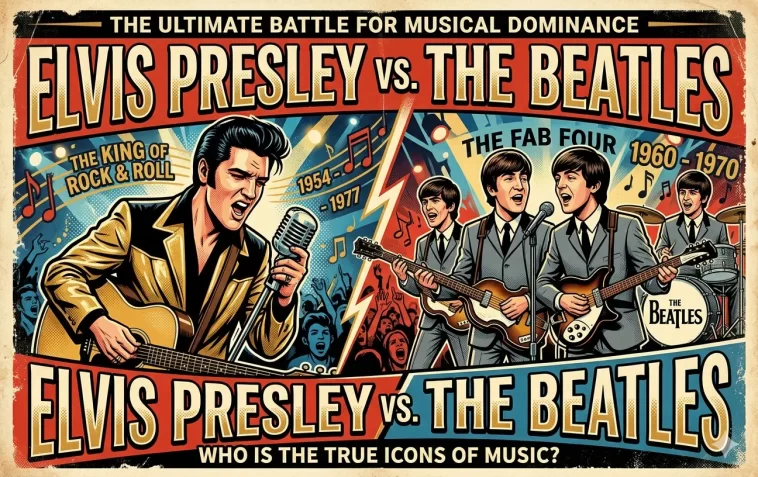
Elvis Presley vs The Beatles — ask any music fan and you’ll start a debate that never truly ends. One man from Mississippi who shook his hips and rewrote the rules. Four lads from Liverpool who arrived like a tidal wave and swept everything away.
Both sides have passionate defenders. Both have undeniable arguments. And honestly, both changed the world in ways that are still being felt today.
So let’s dig into it properly — no filler, just facts, comparisons, and a honest look at what made each of them truly great.
The Origins: Where It All Began
Elvis Presley: One Man, One Voice, One Revolution
Elvis Aaron Presley grew up poor in Tupelo, Mississippi. He absorbed gospel music at church, heard country on the radio, and soaked in the rhythm and blues coming out of Black neighborhoods nearby. When he walked into Sun Studio in Memphis in 1954, that mix exploded into something nobody had ever heard before.
By 1956, Elvis was everywhere. Heartbreak Hotel hit number one, he appeared on The Ed Sullivan Show in front of 60 million viewers, and teenage America lost its mind. He wasn’t just a singer — he was the first rock and roll superstar. A one-man cultural earthquake.
The Beatles: Four Voices, One Unstoppable Force
John Lennon, Paul McCartney, George Harrison, and Ringo Starr came from working-class Liverpool in the north of England. They played tough venues in Hamburg, refined their sound for years, and by 1963 had ignited Beatlemania across the UK.
When they landed in America in February 1964, they appeared on The Ed Sullivan Show — the same show that had launched Elvis eight years earlier. Over 73 million people watched. It was the largest television audience in American history at that point.
The British Invasion had begun. And popular music would never be the same.
Head-to-Head: The Key Categories
Music Sales
Both artists are among the best-selling musicians in history, but the numbers tell an interesting story.
Elvis Presley:
- Estimated 500 million records sold worldwide
- 18 number-one singles on the Billboard Hot 100
- More RIAA-certified gold and platinum albums than any other solo artist
The Beatles:
- Estimated 600 million records sold worldwide
- 20 number-one singles on the Billboard Hot 100
- Best-selling band in history — by a significant margin
- In April 1964, they held the top five positions on the Billboard Hot 100 simultaneously — a record that has never been broken
By raw numbers, The Beatles have the edge. But Elvis had a much longer career — active from 1954 until his death in 1977. The Beatles only released studio albums together from 1963 to 1970. Seven years. The fact that they outsold Elvis across a shorter window says a lot.
Songwriting and Artistic Evolution
This is where the comparison gets really revealing.
Elvis was not a songwriter. He was an interpreter — and a brilliant one. He could take any song and make it his own. But the songs themselves came from other writers. His team selected material; Elvis delivered it.
The Beatles, particularly Lennon and McCartney, were one of the greatest songwriting partnerships in the history of popular music. They wrote almost everything themselves — and they evolved rapidly and deliberately.
Compare Love Me Do (1962) to A Day in the Life (1967). That’s five years. The musical distance between those two songs is extraordinary. They went from simple pop songs to orchestral arrangements, psychedelic experimentation, and deeply layered lyrics in a remarkably short time.
George Harrison also developed into a significant songwriter, contributing classics like Something and Here Comes the Sun — which Paul McCartney has called one of the most beautiful songs ever written.
On songwriting alone, The Beatles have a clear advantage.
Live Performance and Stage Presence
Here’s where Elvis makes up serious ground.
Elvis on stage was unlike anything audiences had seen before. His physicality, his confidence, the way he connected with a crowd — it was instinctive and overwhelming. His 1968 Comeback Special remains one of the most riveting live performances ever recorded. Even in his Las Vegas years, bloated setlists and all, he could still bring a room to silence with just his voice.
The Beatles were also excellent live performers — especially in their early years. Their tight harmonies and raw energy at the Cavern Club and on their early tours were thrilling. But they stopped touring in 1966, partly because they couldn’t hear themselves play over the screaming audiences, and partly because their studio work had grown too complex to reproduce live.
After 1966, The Beatles never performed a full concert again.
For live performance and sustained stage presence across a career, Elvis wins this one.
Cultural Impact
Both artists changed culture. The question is how, and how deeply.
Elvis broke barriers in race and music. In the segregated America of the 1950s, he brought Black musical traditions — blues, gospel, R&B — to white mainstream audiences. He didn’t steal those traditions; he was genuinely shaped by them, and in doing so, he helped open doors for Black artists to reach wider audiences. He gave young people a new identity, a new way to move, a new way to rebel.
The Beatles changed what music could be. They pushed the boundaries of recording technology, studio experimentation, and lyrical depth. Sgt. Pepper’s Lonely Hearts Club Band (1967) is still considered one of the most influential albums ever made — not just for its music, but for the idea that a pop album could be a unified artistic statement.
They also arrived at a pivotal moment in American history. The Beatles hit the US just three months after the assassination of President John F. Kennedy. The country was in grief. Beatlemania offered something joyful and new at exactly the right moment.
Beyond music, The Beatles influenced fashion, film, philosophy, and even spirituality. Their trip to India in 1968 and their embrace of Transcendental Meditation brought Eastern philosophy to Western mainstream culture in a way that had never happened before.
Influence on Other Artists
Who cited Elvis as an influence:
- John Lennon (“Before Elvis, there was nothing”)
- Bob Dylan
- Bruce Springsteen
- David Bowie
- Johnny Cash
- Carl Perkins
- Virtually every rock and roll artist of the 1950s and 1960s
Who cited The Beatles as an influence:
- Almost every major rock, pop, and indie artist from 1964 onwards
- Oasis (Noel Gallagher has called them the reason he picked up a guitar)
- Radiohead
- The Rolling Stones (who openly admitted early debt to The Beatles’ success)
- David Bowie
- Elvis Costello
- Taylor Swift
- Billie Eilish
Here’s the fascinating thing: John Lennon cited Elvis as a primary influence on The Beatles. So in a real sense, without Elvis, there may have been no Beatles. The chain of influence runs directly from Tupelo, Mississippi to Liverpool, England.
Albums: A Closer Look
| Album | Artist | Year | Significance |
|---|---|---|---|
| Elvis Presley | Elvis | 1956 | First rock and roll album to reach No. 1 |
| Please Please Me | The Beatles | 1963 | Recorded in a single day; launched Beatlemania |
| Sgt. Pepper’s | The Beatles | 1967 | Redefined what a pop album could be |
| Abbey Road | The Beatles | 1969 | Often called their greatest studio achievement |
| Elvis’ Golden Records | Elvis | 1958 | Defined the concept of a greatest hits album |
| From Elvis in Memphis | Elvis | 1969 | Critically acclaimed late-career masterpiece |
Grammy Awards
This one surprises people every time.
- Elvis Presley: 3 Grammy Awards (all for gospel recordings)
- The Beatles: 7 Grammy Awards, plus a Grammy Lifetime Achievement Award
Neither total feels adequate for artists of this stature. The Grammy organization has since acknowledged that Elvis’s contributions were dramatically under-rewarded during his lifetime.
The Verdict: Who Changed Music More?
This is an honest question and it deserves an honest answer.
If Elvis hadn’t existed, rock and roll might have taken years longer to reach mainstream audiences. He was the spark. The catalyst. The face that made a generation realize music could be physical, rebellious, and deeply personal.
If The Beatles hadn’t existed, popular music would have taken a completely different path. They didn’t just perform music — they reinvented it, repeatedly, within the space of a single decade. The studio album as an art form, the music video as visual storytelling, the idea that pop musicians could be serious artists — all of that owes a debt to The Beatles.
If forced to choose who changed music more, most music historians lean toward The Beatles — simply because the breadth and depth of their influence across songwriting, recording, production, and culture is hard to match.
But Elvis deserves enormous credit for making the entire thing possible in the first place. He built the stage. The Beatles transformed what happened on it.
FAQ: Elvis Presley vs The Beatles
Q: Did Elvis and The Beatles ever meet? Yes — once. In August 1965, The Beatles visited Elvis at his home in Bel Air, California. By all accounts it was a friendly evening of music and conversation. John Lennon reportedly said afterward that it was one of the greatest moments of his life.
Q: Who sold more records, Elvis or The Beatles? The Beatles have sold an estimated 600 million records worldwide, compared to Elvis’s estimated 500 million. The Beatles hold the title of best-selling musical act in history.
Q: Who had more number-one hits? The Beatles had 20 number-one singles on the Billboard Hot 100, compared to Elvis’s 18. Both totals are extraordinary by any measure.
Q: Did The Beatles admire Elvis? Deeply. John Lennon famously said “before Elvis, there was nothing.” All four Beatles grew up listening to Elvis and credit him as a direct influence on why they wanted to make music in the first place.
Q: Why did The Beatles stop touring in 1966? A combination of factors — they couldn’t hear themselves over screaming audiences, the increasing complexity of their studio recordings made them impossible to reproduce live, and growing exhaustion from constant touring. Their final concert was at Candlestick Park in San Francisco in August 1966.
Q: Who was a better vocalist — Elvis or the Beatles? It’s comparing different things. Elvis was a solo vocalist with a remarkable natural voice — powerful, versatile, emotionally expressive. The Beatles featured four distinct voices and pioneered multi-part harmonies in pop music. John Lennon and Paul McCartney are both considered among the greatest rock vocalists ever. It’s genuinely a matter of personal taste.
Q: Who had more cultural impact outside of music? The Beatles had a broader cultural footprint beyond music — influencing fashion, film (A Hard Day’s Night, Help!), Eastern philosophy, and political thought. Elvis was hugely influential in fashion and film, but The Beatles’ cultural reach extended further in terms of social and intellectual movements.
Q: Is Elvis still popular today? Absolutely. Elvis remains one of the most recognizable figures in entertainment history. His home, Graceland in Memphis, Tennessee, attracts over 600,000 visitors a year and is one of the most visited private homes in the United States.
The debate between Elvis Presley and The Beatles isn’t really about who was better. It’s about two different kinds of greatness at two different moments in time. One lit the match. The other burned down the building and rebuilt it entirely. Music needed both.